Showing posts with label Epona Approach. Show all posts

Wednesday, May 25, 2011

Embrace the World Within


Last week I attended my second Epona workshop ever. Two years ago, when I plunged into the Epona world of authenticity and emotion for the first time, the experience blew me away and left me a changed person. Although I had been around horses nearly all my life, their capacity to know my deepest secrets caught me by surprise. I was awed by their emotional intelligence.

Going into this second experience, called Accessing Authenticity, was very different. This time I would attend the workshop with Melissa, my best friend. I also wanted to believe I had evolved emotionally in the past two years. But, I also knew that whatever my expectations were, they would pale in comparison to the reality. I was right. I may have been prepared for the wisdom horses have to offer, but their uncanny ability to look into my heart and see what nobody, even myself, had not seen before still does not seize to amaze me.

Perhaps the most revealing of sessions happened with Bramble, a white pony that I felt drawn to from the first time I saw her. It wasn’t her outer appearance that interested me (although she was very cute!), but rather this feeling that she had a message for me. So, when we could choose the horse for our reflective round pen session, the choice was really not mine, but Bramble’s.

I have to mention that last time I did reflective work with a horse in the frame work of an Epona course, my biggest problem was the interference of my head. Most of us have this problem; our thoughts and rational thinking get in the way of what our body and soul is trying to tell us. It is not the easiest task to shut this “voice of reason” off. In fact, it is what Linda Kohanov calls The False Self that often runs our life, giving us no time or space to really feel who we are. Social conditioning, self-judgment, assumptions of others, our need to seek approval, our critical and controlling beliefs are all different ways for the False Self to interfere with our intuition, our Authentic Self.

With this in mind I approached the round pen; I was determined to shut off my False Self and give room to whatever was to come, no matter how irrational or confusing this information may be. The object of the exercise was to treat all emotions, images, words or whatever else appeared as valuable information. This was not about succeeding or achieving a set goal; this was about being in the moment and really listening.

Standing outside the round pen and facing away from Bramble, I started with a body scan. Silently, with closed eyes and my arms hanging loosely on my sides, I “scanned” my body for feelings of pressure, pain, heat, cold – any sensation really. I was immediately drawn to the feeling of pressure around my throat and chest. It was not a painful feeling, but rather felt as if I had a heavy blanket wrapped around me, pressing on the front of my shoulders. Through this pressure I could feel my heart beating in my chest; a strong, clear rhythm, as if standing there required physical effort. I asked myself what was the message behind this feeling and received a picture of myself holding a large ball. When I focused on that image, I could feel my heart beat dissipate into the rest of my body, still pulsating, but with less vigor. This was a sign that I had understood the message my body was trying to tell me. Without questioning this perhaps confusing information I ordinarily would have dismissed as “stupid” or “weird” (A ball? Makes no sense. Why was I holding it? etc.), I turned around and looked at Bramble. She was standing in the round pen, staring at me intently with her ears forward. I closed my eyes again, opening my mind to any other images or messages that would come from the horse.

Immediately, as if I was watching a powerful dream, I had a vision of a very small door. It was in the middle of a stone wall far, far away. I had a strong feeling I was supposed to go through the door, but I could see it was closed. I silently asked Bramble what this meant, could she possibly help me? When I opened my eyes again to look at her, I knew she had the key to this door.

Rosie, the facilitator, asked me what was going on. I filled her in. She nodded and said:

“Do you feel like you need more information on what this is about or do you feel ready to go into the round pen?”

This is the brilliance of being part of the Epona method. I’m fairly sure nothing I said could have fazed Rosie. I had told her about my images about the ball and the door, and in any other context this would have made no sense whatsoever. Imagine trying to explain this to a stranger; I would have sounded crazy. And perhaps you, too, now reading it, are thinking I have lost my marbles once and for all. But it all felt natural. I was confident and relaxed going into the round pen.

I walked over to Bramble and gave her a horse-human handshake, extending the back of my hand out for her to touch. Then I stepped back, closing my eyes. Immediately I was taken back to the image of the door. I asked Bramble what I should do with the door, did she have the key?

“No, no key,” she answered, “The door is already open.”

And she was right, for in that moment I saw the whole wall split open. Suddenly I realized that I was holding the ball again, it was enormous and my hands barely reached around it to steady it on my chest. But now I saw it was not a ball after all, it was the Earth; I had the entire world in my arms. I held onto it tight as I stepped through the wall, towards light.

And that is when I understood what Bramble was trying to help me understand. For some months now I have been planning a move to Finland. Despite this move being a choice that I made with my husband, I have been extremely anxious about the decision. Should we have decided to go to California instead (this is where we lived before Switzerland)? Are we taking a risk going to Finland? What if it doesn’t work? What was there really in Finland for me? In the midst of the logistics of the move, the concrete, everyday tasks, I had not allowed myself to truly reflect on my true emotions concerning the move.

I was filled with a strong sense of knowing, which I cannot even begin to describe, as words have their limitations. I realized I had lived in Switzerland for six years, but had never truly been happy there. Why? This question has gone unanswered until that very moment in the round pen. I have met many wonderful people in Switzerland, people whom have made a definite impact on my life. But, despite these friendships, I feel strongly disconnected from the world around me. This probably partly stems from the fact that during my years in Switzerland, I have gone through some major changes in my life, searching for the right path with horses and myself as a person. In other words, I feel separate and detached.

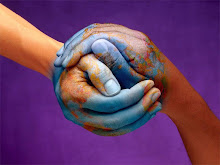
Moving to Finland is an opportunity to change this. In Finland I will be welcomed by a group of close friends, but also a larger network of like-minded people with whom I have connected long distance over the years. For the first time since I left California six years ago, I have the opportunity to be part of a true community; to be supported and accepted as who I am. The realization of this was profound and I felt like a weight was lifted off my chest. Hope for the future was restored. In fact, as my eyes were still closed, I saw the enormous globe I had been holding slowly sink into my chest, as if I was swallowing Mother Earth itself. And isn’t this true? Community is not something outside of us, but rather an internal phenomenon that we cherish and that connects us to others. Instead of seeing myself as someone roaming the earth looking for answers, I needed to embrace the world within.

I had been squatting down on the ground, but now I stood up and opened my eyes. Bramble was looking at me quizzically with her wise, beautiful eyes. I stepped to her side and said a silent thank you. She touched me with her nose and the air was filled with gratitude. Then she walked to the gate as if to say “my work is done.” Which it was.

I left the round pen with a newly found peace. Life would be alright, I would be alright. Why had I not seen this all before? I had been so focused on getting myself, my horse, my family to Finland, that I had not taken the time to stop and realize what moving back to my home country really meant to me. When I returned to my chair and recapped the round pen experience to Rosie and Melissa, I became very emotional, but in a good way. The tears that surfaced were tears of relief and joy and hope, tears I should have shed a long time ago, instead of bottling them deep inside.

Intuition is perhaps the most important piece of our genetic makeup. Unfortunately it is usually the first piece we lose, when life gets the best of us. Most people ignore their intuition. Actually, most people wouldn’t even recognize their intuition, even if it hit them in the head (which it often does…). Animals, such as horses, operate in the world using their intuition, their sixth sense of “knowing”. Often I think that our ability to speak is what stifles our innate knowing of what we need, what is right for us, and only us. The great French writer, Gustave Flaubert, wrote about this in his first novel, Madame Bovary, when he said that “…the truth is that fullness of soul can sometimes overflow in utter vapidity of language, for none of us can ever express the exact measure of his needs or his thoughts or his sorrows; the human speech is like a cracked kettle on which we tap crude rhythms for bears to dance to, while we long to make music that will melt the stars.”

I left England and the Epona course with a better sense of knowing. I felt more at peace than I had for a long time, more in my body rather than in my head. So often, especially in a time of turmoil, my head takes over and I am plunged into a destructive pattern of frantic thinking. I am not saying thinking is a bad thing, but enough is enough. Sometimes we need to stop and take tally of what we really feel and where those feelings are coming from. What are those feelings telling you? What is the message of your intuition? What does your heart desire?

I believe that if we open ourselves to life, life will flow freely into our bodies and we will be able to feel the present moment more deeply. Yes, this can be scary at times, as often there are emotions within us that are not comfortable. But each emotion is a pool of information. If we learn to treat our feelings as messages from our heart, our lives can have so much more meaning.

I thank Bramble and all the horses in the world for not giving up on us humans. You seem to always be ready to help us the moment we are ready to receive the help. I don’t think I can ever understand this gift you have, but I know I will admire it forever.

~K

Wild Geese

By Mary Oliver

You do not have to be good
You do not have to walk on your knees
for a hundred miles through the desert, repenting.
You only have to let the soft animal of your body
love what it loves.
Tell me about despair, yours, and I will tell you mine.
Meanwhile the world goes on.
Meanwhile the sun and the clear pebbles of the rain
are moving across the landscapes,
over the prairies and the deep trees,
the mountains and the rivers.
Meanwhile the wild geese, high in the clear blue air,
are heading home again.
Whoever you are, no matter how lonely,
the world offers itself to your imagination,
calls to you like the wild geese, harsh and exciting - -
over and over announcing you place
in the family of things.


To learn more about Rosie and her courses, go to http://horsesasteachers.co.uk/
To learn more about Epona, go to http://www.taoofequus.com/

Friday, March 11, 2011

Naked Flesh of Feeling

How much has to be explored and discarded before reaching the naked flesh of feeling. ~Claude Debussy


Do animals have emotions?

Having been involved with animals all my life, I have no doubt in my mind that they do. If you own a dog, cat, horse or any other animal, you know what I’m talking about. Animals are intelligent and feeling individuals; they know things that are not visible to the naked eye, often more accurately than us humans. But it wasn’t so long ago that the majority of people denied the existence of animal emotions. In fact, skeptics remain, many whom draw their conclusions from the lack of scientific proof; consequently the emotional lives of animals has not been researched much in the past mainly because researchers thought there wasn’t anything to study in the first place. Luckily research has evolved and proof is emerging from the woodworks of the scientific world. I guess at this point the question is not if animals have emotions, but rather what kind of emotions do they have.

Author and ethologist Marc Bekoff provides evidence of animals having emotions in his book, The Emotional Lives of Animals. The following story is an excerpt from his book:

“A few years ago my friend Rod and I were riding our bicycles around Boulder, Colorado, when we witnessed a very interesting encounter among five magpies. Magpies are corvids, a very intelligent family of birds. One magpie had obviously been hit by a car and was laying dead on the side of the road. The four other magpies were standing around him. One approached the corpse, gently pecked at it-just as an elephant noses the carcass of another elephant- and stepped back. Another magpie did the same thing. Next, one of the magpies flew off, brought back some grass, and laid it by the corpse. Another magpie did the same. Then, all four magpies stood vigil for a few seconds and one by one flew off.”

Often pet owners who say their pet is happy or sad or mischievous or sorry are accused of giving animals “human” emotions. This practice, also known as anthropomorphism, is widely criticized, and for a reason. as often it is connected to disturbing behavior such as dressing your dog up in human clothes or punishing your horse for something that happened long time ago because “he knew what he was doing.” But when it comes to feelings, why should humans have the monopoly on emotions? Look at the story of the magpies; how can you possibly interpret the behavior of the four magpies in any other way than through emotional vocabulary? The birds were obviously mourning the loss of their conspecific; they were sad.

Recently, I read the book Second Nature by animal behaviorist Jonathan Balcombe and Wild Justice by Mark Bekoff in which they explore the emotional and intellectual lives of animals. Even though I have been a big believer in animal emotions for quite a while, I don’t think I had quite understood the depth of the subject. It was fascinating to read scientific proof of emotions in creatures big and small. We often think that for example animals such as fish or rodents don’t have much going on in terms of intelligence or feelings, but turns out they can have feelings like empathy for each other. Mark Bekoff recounts a study made with rats, where caged rats were taught to press a level for food. Once this behavior was set in, however, the scientists added a twist; when the rat pushed the lever to get the food, another rat in the cage next door received an electric shock via the metal floor. What did the rats do? They stopped eating. Some individuals were known to starve themselves for as long as 14 days. I wonder how humans would “excel”to starve themselves in this sort of an experiment… (I also find it sickening that this was a study on rat empathy, but the empathy of the human researchers seemed to fail as they subjected other living beings to such cruel experiments…)

Jonathan Balcombe in particular writes eloquently about animal empathy, an emotion non-animal people often dismiss as solely a human emotion. But anyone who has ever been close to a horse when they have needed a friend, might know the capacity they have for empathy. And not just empathy, but unconditional support.

Two years ago I participated in an introductory workshop of the Epona method (check out my blog from June 16,2009 Lessons from a Horse’s Heart). At the end of the three day course, I felt like I was at the core of my true self, all my emotions were raw and real. Our very last exercise was an individual session with a horse that was assigned to us by the psychologist. My horse was Geo, a young paint gelding with whom I had worked with before, but had failed to find a deep connection. I was last to go and when it came my time to step up to have a private talk with Kathleen Barry Ingram, the facilitator, I was shaking with so many feelings I didn’t even know where to start unwinding them. It had been a long weekend observing others fall apart and collect the pieces as they made an attempt to re-establish themselves and I felt like an outsider in many respects. There were so many other people at the course who had real problems, people who deserved and needed the help of the horses and humans there. I, on the other hand, felt like I often feel; that I was there to support others instead of to receive support.

I approached the round pen where Geo was grazing at the other end completely disinterested in me. Kathleen pulled me aside and asked how I was feeling. I shrugged.

“I really feel like I don’t belong here,” I said. “All these other people are battling such major emotional issues and traumatic pasts. I don’t have that. They need this, they need the support.”

“So you feel like you don’t deserve to have that?”

“Yeah, I guess so. It’s always like this, you know, I hold up everyone else, but it’s only because I don’t need holding up. Kind of like there is a big pie and everyone else gets a big slice. In the end there isn’t much left for me. But that’s okay, because I don’t really need the pie.” I looked at Kathleen. “Do you know what I mean?”

Kathleen nodded. “But you know what? You deserve your own piece. You deserve this time, this sacred space of possibility. You deserve support, too. Look at all those people.” She motioned towards the 20 odd students sitting in their chairs, ready to observe my interaction with Geo. “They are here for you. Maybe you don’t feel deserving of their time, but they are here, nevertheless.” She motioned at Geo. “And look at that horse.” I looked at the horse, he couldn’t have looked less interested in Kathleen and me. “He is here for you.” She pushed on my back gently. “Now go and see what he has to bring to the table.”

I opened the gate to the round pen and walked in. Suddenly my hands were shaking. And not just my hands, but my whole body was quivering, as if it was a little blade of grass in a storm. Geo didn’t move, he didn’t as much as look at me. I started crying. I don’t know why I was crying, but there was an unstoppable wave of sorrow and sadness inside me that erupted to the surface so suddenly that I couldn’t stop it. I started sobbing, something completely uncharacteristic to me.

Overwhelmed by my emotions, I stopped about ten feet away from the grazing Geo. The last thing I wanted to do was force my emotions on him. Tears were flowing down my face, I don’t think I have cried like that since childhood. I looked at Geo and wanted to leave, to just run out of there and hide somewhere. But just then he lifted his head and looked back at me. Then he turned and walked over. He stopped in front of me. I was still sobbing and it felt like the top of my head was going to explode, the pounding was so strong, so blinding that I closed my eyes. An ache grew in my chest and even though I wanted to clutch my hands to it, I let my arms hang at my sides, exposing myself completely in front of this horse.

Geo lifted his nose and pressed it to my chest. I could feel him breathing into me. I could also feel something else, a strange sensation of lightness, as if this horse I barely knew was sucking the irrational sadness out of me like an enormous vacuum. I opened my eyes and Geo moved his nose to my forehead and performed the same exercise there, sucking away my pain, pulling it out of me and sending it off into the universe.

I stopped crying. Geo took his nose off my forehead. I swear the look on his face was playful. He grabbed the cloth of my sleeve between his lips and pulled on it. Come now, he seemed to say, let’s be done feeling sad.

Without thinking I turned and started running down the round pen. Geo squealed and took off at a canter, bucking and romping around like the teenager he was. I laughed out loud. I don’t think I have ever felt so alive and so light, like I could have perhaps taken off in flight. We ran another round and then Geo stopped to graze and I walked to the gate. The whole interaction had taken perhaps four minutes, but it had been an intense four; he had given me exactly what I needed, his time and his support – his empathy. I came through that gate with a new respect for horses as sentient beings.

Exploring animal emotions brings us face to face with many ethical questions; perhaps the real reason humans have so reluctantly studied this subject. What you don’t know can’t hurt you, right? If we admit to animals being sentient beings with rich emotional lives, how do we possibly justify the way we treat them? What does the current treatment of animals tell us about ourselves? I for certain think about this question on a daily basis. Do we have the right to use horses for our own pleasure? And how do they feel when we do? For thousands of years we have assumed an inferior role over nature and other animals. Perhaps it is time for us to notice and acknowledge animals as who they really are; subjects of their own lives, living and feeling beings

Geo and the other horses at the Epona workshop exposed the very essence of horses. Ever since I had this experience, I have not been able to stop seeing the hidden meaning behind each horse-human relationship I encounter. When we are initially drawn to horses, perhaps it is not the action of riding or training or driving or grooming that touches us so deeply, but rather the soul of the animal we are connecting with, or rather, who is connecting with us. Horses, even the ones that live under stressful conditions, have the capacity to emotionally heel humans. Often we don’t know this when we meet them, but the potential is always there. Horses are altruistic; they give selflessly, even when the human is not paying attention.

In his book Second Nature Jonathan Balcombe tells so many touching stories of animals caring for each other, working together, striving to understand each other, seeking comfort from each other – even in the most surprising situations. I want to share one particular story with you, because it perhaps demonstrates the capacity that animals can have for empathy, even across species. This is a story about Washoe, a chimpanzee.

Balcombe writes: “… Beatrice and Allen Gardner of the University of Oklahoma taught American Sign Language to Washoe. When Beatrice became pregnant, Washoe became more attentive than usual and regularly asked questions (using sign language) about the baby. Washoe had had two pregnancies of her own, both of which had resulted in the infants’ deaths. When Beatrice returned after an extended absence, Washoe acknowledged her return but was aloof. The teacher explained that she had had a miscarriage and signed to Washoe: “My baby died.” Washoe looked at Beatrice and signed “Cry”, then signed “Please person hug” as Beatrice was leaving.”

Sometimes there are no words for what we feel when we are with our animals and it is because emotions are beyond words. In fact, spoken language can even block being able to feel and read the emotions of others. Perhaps that is why animals are better at it than us humans are, they are used to communicating nonverbally. My written account of the moment with Geo doesn’t do justice to what really happened, because there are no words to truly describe the matters of the heart. All I can say is that I wish to connect again and again to that sacred place he opened up in me.

~K

“It is of interest to note that while some dolphins are reported to have learned English – up to fifty words used in correct context – no human being has been reported to have learned dolphinese.”
- Carl Sagan

Tuesday, June 16, 2009

Lessons from a horse's heart

The first time I met Kapia, I didn’t know who she was. She stood in the middle of the pasture as if she owned it. And I suppose in many ways she did. She certainly was the equine boss of that particular grassy meadow; this chestnut horse knew her place in the world, and it was not behind someone else. But at that moment, when I watched her over the fence, she was still just another horse to me.

I was in Belgium and about to take part in the workshop titled “Reclaiming Your Authentic Self – An introductory workshop to the Epona Approach”. Before the three day course started, however, I was scheduled to have a private session with therapist and life coach Kathleen Barry Ingram and, well, with a few horses.

Kathleen started the session by asking what it was that I wanted to “work” on. I replied that I felt I had some underlying guilt and sadness of unknown origin; I was not exactly sure where this emotion was pooling from, but wanted to explore it further. Kathy suggested we head to the horses and ask for some answers.

At this point I didn’t know what to expect. Maybe I was a little skeptical; what could horses tell me about myself that I didn’t know yet? And how would they even do that? On the other hand, I was eager to discover something new. I was also nervous; I was used to “working” horses, but to just be with them and feel? This was somehow intimidating. What if I failed?

There were two horses in the pasture: Kapia, the undeniable leader I had been watching from afar and Luna Nour, a small and delicate looking Arab mare. Both were grazing peacefully as we sat down. I watched the horses for a while and Kathy asked me to describe the thoughts coming to my mind. I said that I didn’t feel like I ever had enough space to be sad, that I was always the one to hold everyone else afloat, to support them through life’s ups and downs. This thought led me to thinking about my life over ten years ago, when I had ovarian cancer, something that had obviously been very hard for me, but had been even harder for the people close to me, I felt.

Now, I had not come to the session thinking I would talk about my bout with cancer, I had long time ago dealt with that part of my life and felt it was behind me, in every sense. But there I was, talking about it again as if it had happened recently. I looked at the two horses and they both blew air out of their nostrils and shook flies off their heads before settling back to eat. Was this coming from them?

Kathleen asked me to elaborate on the subject and I became very emotional as I admitted that during my illness I had dealt with feelings ranging from fear of dying to worrying about my loved ones, but I still vividly remembered the deep sorrow I had felt when I realized that I would never be able to have biological children. And even though years later I had been, with the help of modern medicine, blessed with a child, I still somehow felt “childless” in my heart; despite motherhood, the feeling had never left me completely.

“What do you want from the horses?” Kathleen asked. I looked at her quizzically. Was I allowed to want something?
“Support, I suppose,” I said.

Kathleen sent me into the pasture to “talk” to the horses. I stood in the middle of the field with my eyes closed and when I opened them Luna, the younger mare, came close to me. Without being pushy in any way she wrapped herself around me, bringing her delicate horse body literally into my lap. I had never been hugged by a horse before and was choking with tears when I felt the love that radiated from this little mare. She was so incredibly pure and honest and undamaged, and it was refreshing to be close to a horse of that quality, her innocence reminding me of my seven year old son at home.

Then Kapia walked over. She pushed the little mare out of the way and marched right to me, settling her large head in my arms. “Scratch my head” she seemed to say and as I lay my hand on her wise forehead I was filled with a sense of motherhood radiating from this strong mare, as if she was there to take care of me, to show me the way. I could feel my own emotions whirling around in my body and there is was again, the “childless” feeling. Why was I even dwelling over that? Why did I feel so sad? I had a child, I was a mother and loving every minute of it.

Kathleen, who was standing along the fence with the owner of the two horses, called me back for a brief discussion.
“I think you need to know something about Kapia,” she said. “Because of a structural problem, the mare cannot have babies.”
I glanced at the brown mare grazing in the pasture and let the words sink in. This was no coincidence, I knew it then and there. This is why I was digging so deep for these long lost emotions of childlessness; Kapia had brought me to the edge of these questions because they were not just my questions, they were hers as well. Because she knew what was inside me even when I didn’t.

Kathleen sent me back to talk to the mare and as I walked towards her, my body was shaking with emotion. Kapia sighed and touched my hand with her nose and then suddenly there it was – the truth. I started crying quietly next to the horse that had opened up my very soul. Kathleen looked at me from over the fence.
“I know what it is now,” I said. “I know where the guilt is coming from.” I choked on my own words. “I feel guilty that I have my son.” I paused, shocked by what I had just said, what I was about to say. “I feel like I don’t deserve him.”

Just to say the words was hard enough, but to think them, feel them… I could see my beautiful son waiting for me at home, his sunshine eyes, the ripple of his laughter. How could I even begin to feel guilt? Why could I not accept this miracle, this gift that had been given to me after all the hardship I had endured? With the tears came a wave of relief, an ocean of understanding. Kapia leaned into me and our hearts touched. You deserve him, you deserve happiness, you deserve the world. I could hear the words the old, wise mare told me; you deserve every bit of it.

Luna appeared from behind and crept quietly to my other side. And soon I was surrounded by two warm horse bodies, their hearts and spirits opening up a sacred space of possibility for me, just for me. Here was the not only the answers I had been looking for, but the support I had asked for, as well. I was receiving it tenfold.

What I walked away with from the session with Kathleen and the two horses is the realization that I need to support myself more, we all need to support ourselves more. Like Kathleen says: “Healing begins when you reclaim and embrace yourself.” Yes, we all need to do that more.

Since, I have spent a lot of time reflecting on the teachings of Kapia. My relationship with my son has changed from good to even better. Every moment in his company fills me with light. I am working on liberating all the guilt I did not even realize was affecting my relationship with him and other people. I am learning to accept life’s gifts as they come; I am letting the horses in my life teach me that I deserve them all.

My relationship with horses has changed as well. They are no longer just my animal friends, they are more than that; living and breathing and feeling beings with a deeper consciousness we could ever imagine. I am no longer looking to teach a horse how to be in this world, I am looking at the horse to teach me.

Thank you Kathleen for leading me to the water, and to Kapia for showing me how to drink. This experience opened up a passage in me I never knew existed.

K

PS. To learn more about Kathleen Barry Ingram go to her website www.sacredplaceofpossibility.com