
Pleasure is spread through the earth
In stray gifts to be claimed by whoever shall find.
~William Wordsworth, 1806
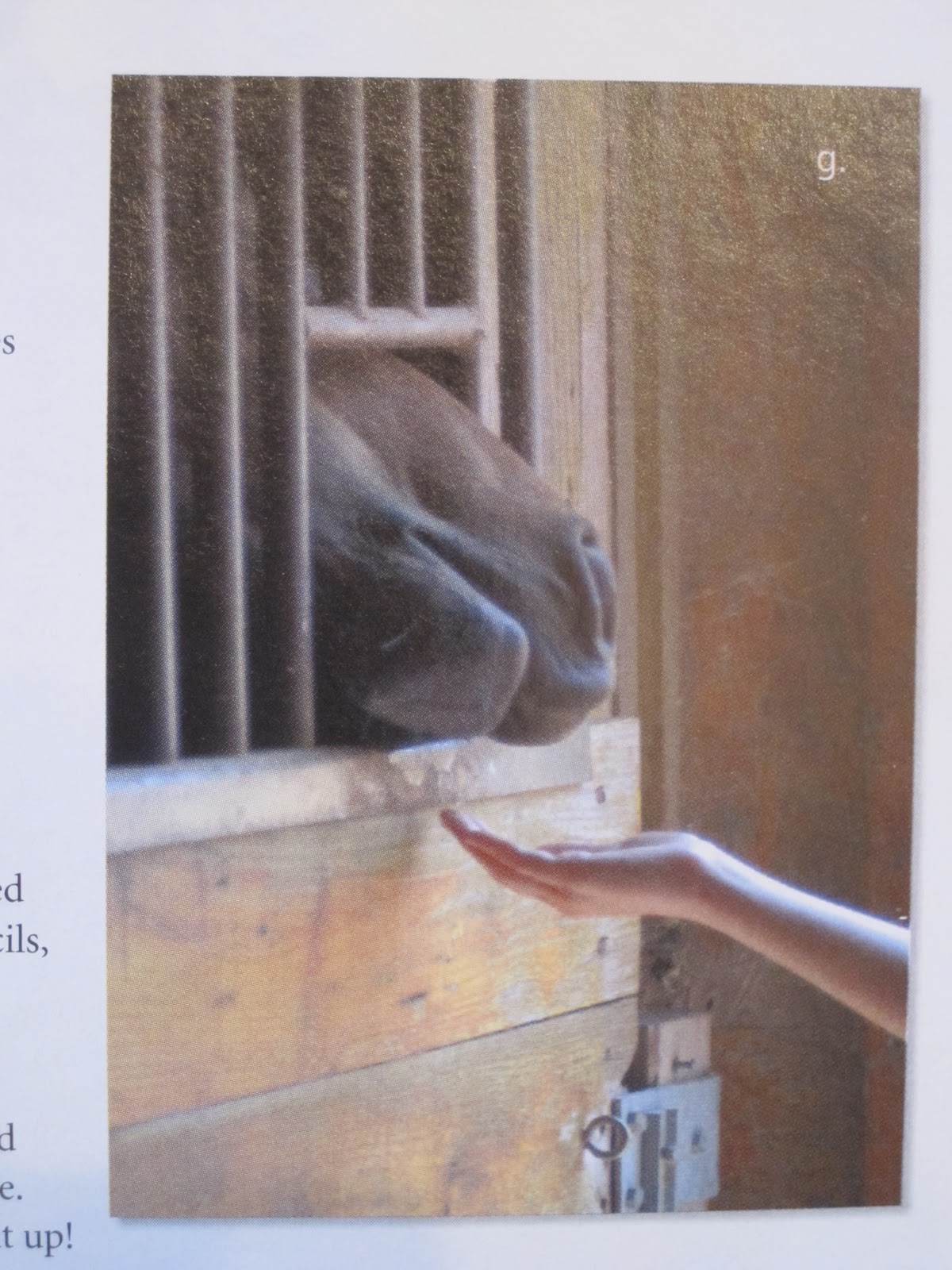
Look at the picture above. What do you see?
What you are looking at is a picture of a poster that is for sale for approximately 20 dollars in an American horse catalogue. The text beside the poster says: “The image of an inquisitive muzzle nuzzling a timid, but determined little hand evokes memories of an experience all horse lovers hold in common.”
The name of the poster is “The Gift”, but I am left unsure as to what gift this is referring to; the imprisoned horse giving the girl the gift of the nuzzle or the girl giving the imprisoned horse the gift of touch.
When I was a child, all the horse posters on my walls (and I assure you, there were MANY), illustrated various horses in freedom. I can’t remember one single one with a tacked up horse, let alone a ridden one or one stuck behind bars. Is this what the equestrian world has come to? Is taking the freedom of another living being so “normal” that it is now even depicted in posters for children? The above picture is supposed to evoke “memories of an experience we all hold in common”. I can tell you it definitely evokes my memories. In fact, some of those memories are of experiences from the not so distant past. I remember writing about one of those experiences in my blog (Levels of Imprisonment, August 29, 2010). I wrote: “But if there is a will, there is a way. The only opening to this horse’s box stall is a small gap above his feeder through which the barn worker delivers the daily grain portions. It is just big enough to fit a human hand and a scoop. And a horse’s muzzle. “
I was writing about a gelding who would twist his neck to an unconceivable angle just to get his nose pushed through the feeder hole. And why? To touch another horse.
Here is a picture I took much later of that very same horse. Unfortunately, this time his neighbor's window was closed and the two horses could not touch. What you see is him reaching out to me.
The similarities to the poster are obvious, but the context completely different. Perhaps my memories are not the memories the catalogue was talking about…
Little Love and I have been gone from her old barn for a mere three weeks, but somehow that short time already feels like a lifetime. At her old barn horses lived in stalls exactly like the one in the poster picture. They rarely were able to touch each other. If it happened, it was an accident or the product of horse ingenuity. Perhaps the top electric wire broke between two pastures or the electricity was left off for a brief moment or a horse managed to get loose from his owner and ran to another horse. Or a horse stuck his nose through his feeder hole. But these were exceptions to the rule. And the rule was no touching.
When we were still there, I did my best to produce the horse to horse touch for Little Love. I know she would have preferred another horse to me as I am a sad replacement, but she took what she could get.
One day not so long ago I was scratching her over the withers, something she loves. As I started rubbing her hard with my fingers, she leaned into me with her nose wiggling. This prompted her new neighbor, a large gelding, to spin around in his stall and stare at me in disbelief. For a moment he merely observed what I was doing, then he took action. He pushed his head against the metal bars that separated his space from Little Love’s. I could see his eyes fix on me. “Come on, rub me, too” he was saying.
I continued rubbing Little Love with one hand as I pushed the fingers of my other hand through the bars. I could just about fit half my hand through. The gelding moved his head and let my fingers scratch over his forehead and nose. Then he positioned his neck to be in line with my hand. So there I stood, scratching Little Love’s withers with my left hand and with my right attempted to reach her neighbor, the big gelding. Both horses stretched their noses out in pleasure and breathed at each other through the bars of the stall.
We are mammals; we all have the need to touch each other and to be touched. Companionship is one of our basic needs, along with eating, drinking, moving and sex. Living in isolation can affect the mental state of any animal, but especially horses, as they are by nature herd animals. Isolation induces stress and a stressed animal cannot learn and train with 100% capacity. Yet ironically it is often the so called performance horses that live in such isolation.
I can now truly see the detriments of forcing an animal to live in a cage. Little Love, the horse that had not had any real horse-to-horse contact for over ten years, has now been going outside with her new friend Col for seven whole days. Due to this fact, she is a changed horse. She is more grounded, more relaxed, more at peace. Yes, she is still coming into a stall at night, but the fact that she can at all times reach over the wall and touch another of her kind, is huge.
I am happy I can finally give her the gift of a social life after all those years of isolation. And there are not a lot of things I enjoy more than watching Little Love interact with her first horse-friend in a decade. Hopefully someday she can give up stall living completely and join a herd living outside, but for the moment, she is visibly content with this small change to her life. In fact, she is so content, that someone could say she doesn’t need me anymore, at least not the way she “needed” me in her previous life. And there is some truth to that, since an imprisoned animal (or person, for that matter) will undoubtedly look forward to any interaction, even if it is with his captor and a member of another species. In that light, can we even pretend to have a real relationship with an animal that is kept in solitary confinement? I have to say that I still feel and hope I had a connection with Little Love before, when she lived a different life. This connection is now evolving and although I definitely have lost something precious (her undivided attention, perhaps?), I have also gained, and continue to gain something else in return, a whole new level of consciousness and connection I never knew about before.
This, I believe, is truly a gift.
~K
If you love something, set it free; if it comes back it's yours, if it doesn't, it never was.
- Anonymous
PS. There is another major detriment to the stall-bound life: insufficient movement. Horses are born to move and they should be allowed to move, day and night. Movement is what keeps their bodies healthy, starting from their hooves but affecting the joints, muscles and other tissues. A horse kept in a stall does not move enough and is thus prone to injury.
Two horses stretching out to touch each other
Monday, January 31, 2011
Friday, January 21, 2011
Just for Encouragement
I object to violence because when it appears to do good, the good is only temporary; the evil it does is permanent. ~ Mahatma Gandhi
Last fall I met a lady, who had just recently gotten back to horses after years of having nothing to do with riding. The woman owned a big gelding with which she rides trails. She had a kind attitude towards her horse, but was nevertheless going down the traditional route, more or less. We were having a conversation about Little Love’s abusive past and how it affected the present day. I was telling her that it was extremely hard for Little Love to witness the abuse of other horses.
“You mean people at your barn hit their horses?” the woman asked.
“Yes, some do,” I said (this was when I was not yet Lilo’s owner and she was still boarding at the big barn close to my house).
The woman shook her head in disbelief. “I have never hit my horse. Ever.”
Ten minutes later, she showed me one of her many crops. “I always carry a whip when I ride though, but it’s just for encouragement. Like if he stops on the trails, I just tap him with it – to help him.”
Everything is relative, I suppose. Violence is not a black and white issue, but rather another one of those grey matters. Nobody wants to say they hit their horse; it is much easier to use words like encourage, guide, correct, help, tell, tap and even smack. And it is true, there are different levels of abuse. To take a four foot whip and hit the horse as hard as you can surely is different than giving him a few slaps on the shoulder.
Or is it really? What are the mental and emotional consequences for the horse that is subject to such actions? Especially when often this sort of behavior is coupled with extremely bad timing and human emotions that are running high?
Horses, unlike other animals, are trained mainly using negative reinforcement instead of positive reinforcement. In positive reinforcement a desired behavior is rewarded by adding a pleasant stimulus, a reinforcer - such as food, and thus making this response more likely in the future. So, in a nutshell, when we use positive reinforcement training, the animal goes from a neutral state to a positive state. This training method has been highly successful with animals ranging from marine mammals to dogs.
In horse-training, however, we apply pressure to the horse and remove it when the animal gives the desired response. Therefore, the horse starts in a negative condition, but ends in a neutral state. So in a way, you could say that negative reinforcement involves the use of a “pre-punishment”. Of course, the goal is to use as little pressure as possible, but because people don’t know any better, are impatient or have a hard time understanding the principles of this method, they often revert to excessive pressure and even punishment. In addition, the timing of the release is essential for learning, but often becomes equally muddled, leading to severe communication problems. And a confused horse is often subject to more abuse.
I also believe that a training method that is based on using pressure often paves the way to abusive behavior; if a person has already learned that it is alright to kick the horse, the next step i.e. hitting it with a crop is all too easy to take.
While I was in California over the holidays, I ran across my old trainer. She and I have grown miles apart when it comes to horses, but we still greet each other as old (but perhaps a bit apprehensive) friends. Conversation turned to horses, what else, and soon I realized I was listening to my trainer reminiscing about an old acquaintance of ours, a student we once shared.
“Remember how she just couldn’t get the horse to move off her leg,” she laughed. “It was terrible, she kept nudging and nudging and nagging and nagging and the horse just stood there. It took her forever to learn to give the aid and then the correction, then another aid and another correction, and so on, until the horse got it. In the end she barely needed the aid and didn’t have to give the correction.”
Nudging and nagging? Aid and correction? This is smart horse terminology. And with smart I mean it makes everything sound less abusive than it really is. What my old trainer was talking about was her student repeatedly kicking the horse to get the horse forward (nudge and nag). Her advice was to give a lighter leg signal (aid – as if the rider is somehow helping the horse with her leg) and then hit the horse immediately afterwards, if and when he didn’t react (this is called the correction). In the end, as the horse is now anticipating the abuse, he will undoubtedly move off the light leg “aid” out of fear and thus the rider won’t “have to” (as if we had no choice in the matter and it was the horse forcing us to take this route) beat him.
In general, talking about “aids” is slightly misleading. In dressage, this word is used frequently to signify the cues the rider gives to the horse with her leg/reins/seat/whip/spurs. In real life this means the pressure the rider/trainer puts on the horse.
In Equitation Science McGreevy and Andrew McLean (my new holy book, it seems) put it well when they comment on the use of the word “aid” in current horse-training, especially dressage: “This word is antique in origin, derived from the French verb ‘aider’, meaning ‘to help’. The notion that cues in any way offer assistance to horses is anthropocentric and… nourishes the notion of the ‘benevolent’ horse, the horse that is a willing partner. Horse-trainers should respectfully recognize that training is an act of equine exploitation rather than equine enlightenment…”
I find the term “equine exploitation” to the point. Because isn’t that really what current horse-training is? Unfortunately, to train a horse in the competition-driven world, it is hard not to rely on negative reinforcement. Yet, unlike positive reinforcement training, the effects of this method have not been studied much. Many trainers don't even know they are using negative reinforcement, as they confuse it with positive reinforcement. In any case, using such a training method without really understanding the principles of learning theory can lead to the use of excessive pressure and punishment.
The other problem in the realm of competitive equestrian sports is that the rules permit hitting horses with whips. When the FEI states in their General Regulations (2007) that “whipping or beating the horse excessively” is forbidden, they imply that hitting the horse is alright, as long as it’s not excessive. And what exactly is “excessive whipping” and how can any outsider be the judge of that? How can we justify any kind of violence, even if it is not “excessive”?
The FEI is the authority in many parts of the equestrian community. Perhaps they don’t directly affect the majority of riders in the world, but indirectly their violent attitude towards horses is significant, because it trickles down to the grass root equestrians, many of whom are children.
How is it possible that the governing body of competitive equestrian sports is supporting punishment as a training method? What good can ever come from the use of punishment? If it isn’t common sense to realize the long-term disadvantages of abusive training, science backs it up. B.F. Skinner, the American behavioral psychologist, concluded years ago that positive reinforcement was greater to punishment in altering behavior. According to him punishment was not simply the opposite of positive reinforcement; positive reinforcement results in lasting behavioral changes, whereas punishment changes behavior only temporarily and presents many detrimental side effects.
So many people claim they don’t hit their horses. I did, too - once upon a time. And if I did hit them, they certainly “deserved” it (which somehow didn't count as hitting, right?). It is easier to hit a big animal than something smaller, say a dog, which on top of cowering down onto the floor will make pathetic whimpering noises. Horses don’t do that – unfortunately.
A while ago I witnessed someone brushing their horse. The horse was extremely unhappy, pinning his ears back and making threats to bite. The person brushing the horse ignored all this and carried on as if nothing was out of the ordinary. And perhaps nothing was; maybe this was how the horse always reacted to brushing.
Finally, after several minutes, the horse crabbed the woman’s arm and bit into it – hard. She yelped in shock.
“How dare you bite me,” she hollered and stared at her horse incredulously. “That’s it, I won’t talk to you anymore,” she continued.
Then, as an afterthought, about ten seconds after the fact, she hit the horse on the neck with her fist. The horse turned his head away; his eyes were tired and there was a sort of accepting look in them. Or was he merely dissociating from the situation? After all, he had tried his best to communicate his feelings to the person brushing him.
Little Love, who had witnessed the whole scene, sighed and chewed and lowered her head. It seemed that she, too, sort of shrugged the incident off. If that horse had flinched or yelped out loud or cowered away from the human who hit him, had it made a difference? Would she have then perhaps seen the consequences of her actions? I’ll never know, because the horse took it like only a horse does, silently, stoically and without an ounce of blame or anger. And before I opened my mouth to share some of my thoughts with the owner, I sent him a message of love – just for encouragement.
~ K
Violence is the last refuge of the incompetent. ~ Salvor Hardin
Last fall I met a lady, who had just recently gotten back to horses after years of having nothing to do with riding. The woman owned a big gelding with which she rides trails. She had a kind attitude towards her horse, but was nevertheless going down the traditional route, more or less. We were having a conversation about Little Love’s abusive past and how it affected the present day. I was telling her that it was extremely hard for Little Love to witness the abuse of other horses.
“You mean people at your barn hit their horses?” the woman asked.
“Yes, some do,” I said (this was when I was not yet Lilo’s owner and she was still boarding at the big barn close to my house).
The woman shook her head in disbelief. “I have never hit my horse. Ever.”
Ten minutes later, she showed me one of her many crops. “I always carry a whip when I ride though, but it’s just for encouragement. Like if he stops on the trails, I just tap him with it – to help him.”
Everything is relative, I suppose. Violence is not a black and white issue, but rather another one of those grey matters. Nobody wants to say they hit their horse; it is much easier to use words like encourage, guide, correct, help, tell, tap and even smack. And it is true, there are different levels of abuse. To take a four foot whip and hit the horse as hard as you can surely is different than giving him a few slaps on the shoulder.
Or is it really? What are the mental and emotional consequences for the horse that is subject to such actions? Especially when often this sort of behavior is coupled with extremely bad timing and human emotions that are running high?
Horses, unlike other animals, are trained mainly using negative reinforcement instead of positive reinforcement. In positive reinforcement a desired behavior is rewarded by adding a pleasant stimulus, a reinforcer - such as food, and thus making this response more likely in the future. So, in a nutshell, when we use positive reinforcement training, the animal goes from a neutral state to a positive state. This training method has been highly successful with animals ranging from marine mammals to dogs.
In horse-training, however, we apply pressure to the horse and remove it when the animal gives the desired response. Therefore, the horse starts in a negative condition, but ends in a neutral state. So in a way, you could say that negative reinforcement involves the use of a “pre-punishment”. Of course, the goal is to use as little pressure as possible, but because people don’t know any better, are impatient or have a hard time understanding the principles of this method, they often revert to excessive pressure and even punishment. In addition, the timing of the release is essential for learning, but often becomes equally muddled, leading to severe communication problems. And a confused horse is often subject to more abuse.
I also believe that a training method that is based on using pressure often paves the way to abusive behavior; if a person has already learned that it is alright to kick the horse, the next step i.e. hitting it with a crop is all too easy to take.
While I was in California over the holidays, I ran across my old trainer. She and I have grown miles apart when it comes to horses, but we still greet each other as old (but perhaps a bit apprehensive) friends. Conversation turned to horses, what else, and soon I realized I was listening to my trainer reminiscing about an old acquaintance of ours, a student we once shared.
“Remember how she just couldn’t get the horse to move off her leg,” she laughed. “It was terrible, she kept nudging and nudging and nagging and nagging and the horse just stood there. It took her forever to learn to give the aid and then the correction, then another aid and another correction, and so on, until the horse got it. In the end she barely needed the aid and didn’t have to give the correction.”
Nudging and nagging? Aid and correction? This is smart horse terminology. And with smart I mean it makes everything sound less abusive than it really is. What my old trainer was talking about was her student repeatedly kicking the horse to get the horse forward (nudge and nag). Her advice was to give a lighter leg signal (aid – as if the rider is somehow helping the horse with her leg) and then hit the horse immediately afterwards, if and when he didn’t react (this is called the correction). In the end, as the horse is now anticipating the abuse, he will undoubtedly move off the light leg “aid” out of fear and thus the rider won’t “have to” (as if we had no choice in the matter and it was the horse forcing us to take this route) beat him.
In general, talking about “aids” is slightly misleading. In dressage, this word is used frequently to signify the cues the rider gives to the horse with her leg/reins/seat/whip/spurs. In real life this means the pressure the rider/trainer puts on the horse.
In Equitation Science McGreevy and Andrew McLean (my new holy book, it seems) put it well when they comment on the use of the word “aid” in current horse-training, especially dressage: “This word is antique in origin, derived from the French verb ‘aider’, meaning ‘to help’. The notion that cues in any way offer assistance to horses is anthropocentric and… nourishes the notion of the ‘benevolent’ horse, the horse that is a willing partner. Horse-trainers should respectfully recognize that training is an act of equine exploitation rather than equine enlightenment…”
I find the term “equine exploitation” to the point. Because isn’t that really what current horse-training is? Unfortunately, to train a horse in the competition-driven world, it is hard not to rely on negative reinforcement. Yet, unlike positive reinforcement training, the effects of this method have not been studied much. Many trainers don't even know they are using negative reinforcement, as they confuse it with positive reinforcement. In any case, using such a training method without really understanding the principles of learning theory can lead to the use of excessive pressure and punishment.
The other problem in the realm of competitive equestrian sports is that the rules permit hitting horses with whips. When the FEI states in their General Regulations (2007) that “whipping or beating the horse excessively” is forbidden, they imply that hitting the horse is alright, as long as it’s not excessive. And what exactly is “excessive whipping” and how can any outsider be the judge of that? How can we justify any kind of violence, even if it is not “excessive”?
The FEI is the authority in many parts of the equestrian community. Perhaps they don’t directly affect the majority of riders in the world, but indirectly their violent attitude towards horses is significant, because it trickles down to the grass root equestrians, many of whom are children.
How is it possible that the governing body of competitive equestrian sports is supporting punishment as a training method? What good can ever come from the use of punishment? If it isn’t common sense to realize the long-term disadvantages of abusive training, science backs it up. B.F. Skinner, the American behavioral psychologist, concluded years ago that positive reinforcement was greater to punishment in altering behavior. According to him punishment was not simply the opposite of positive reinforcement; positive reinforcement results in lasting behavioral changes, whereas punishment changes behavior only temporarily and presents many detrimental side effects.
So many people claim they don’t hit their horses. I did, too - once upon a time. And if I did hit them, they certainly “deserved” it (which somehow didn't count as hitting, right?). It is easier to hit a big animal than something smaller, say a dog, which on top of cowering down onto the floor will make pathetic whimpering noises. Horses don’t do that – unfortunately.
A while ago I witnessed someone brushing their horse. The horse was extremely unhappy, pinning his ears back and making threats to bite. The person brushing the horse ignored all this and carried on as if nothing was out of the ordinary. And perhaps nothing was; maybe this was how the horse always reacted to brushing.
Finally, after several minutes, the horse crabbed the woman’s arm and bit into it – hard. She yelped in shock.
“How dare you bite me,” she hollered and stared at her horse incredulously. “That’s it, I won’t talk to you anymore,” she continued.
Then, as an afterthought, about ten seconds after the fact, she hit the horse on the neck with her fist. The horse turned his head away; his eyes were tired and there was a sort of accepting look in them. Or was he merely dissociating from the situation? After all, he had tried his best to communicate his feelings to the person brushing him.
Little Love, who had witnessed the whole scene, sighed and chewed and lowered her head. It seemed that she, too, sort of shrugged the incident off. If that horse had flinched or yelped out loud or cowered away from the human who hit him, had it made a difference? Would she have then perhaps seen the consequences of her actions? I’ll never know, because the horse took it like only a horse does, silently, stoically and without an ounce of blame or anger. And before I opened my mouth to share some of my thoughts with the owner, I sent him a message of love – just for encouragement.
~ K
Violence is the last refuge of the incompetent. ~ Salvor Hardin
Thursday, January 13, 2011
The Magic of Miracles
I think miracles exist in part as gifts and in part as clues that there is something beyond the flat world we see. -Peggy Noonan
Someone, and I believe the quote is attributed to Lynn Andrews who wrote the book Walk in Balance, said that “for magic to happen in your life, you must believe in magic.” I think she was right. In fact, I think basically if you think of something long enough, it will somehow happen. And that is exactly what happened to me and Little Love.
One Saturday the 9th of January 2011 I became Little Love’s official owner. Even though I wished for this for so long, I still didn’t see it coming when it happened. One day I was teaching her owner to ride the mare and the next she called me and said she was “done” riding the horse. I’m not going to dwell over her reasons for suddenly wanting an out from the ownership of Little Love, as it is part of her personal journey, but in the end she gave me an ultimatum: take her or leave her (in which case she would sell her to a breeder).
This of course happened at the worst possible moment: as I was literally packing my bags for our annual family visit to California – for three weeks. Not much to think, not that I had to think. But, I did have to convince my husband to thinking a horse was exactly what we needed, especially now that we know we will be moving this year – possibly overseas. Luckily I have a pretty understanding husband, and with understanding I mean he supported my wish even though neither of us is made of money.
Yes, I know, he is a saint.
So, long story as short as possible. Two days before our plane was scheduled to leave; I signed papers, withdrew half of my savings from the bank and handed them over to Little Love’s owner. She, in exchange, promised to take care of the horse until I came back. My only option really, as I could not think of anyone else to do that. In the meanwhile I was frantically looking around for a new barn. I knew that when I was back from my trip, I needed to move Lilo out of her barn, not only because of the atmosphere, but because it cost an arm and a leg to keep a horse there. I wanted a stable where she could at least go outside every day, rain or shine, preferably with other horses. I had two days and I was panicking, needless to say.
But then, another miracle. I woke up in the middle of the night and had a vision of a newspaper I once read, four years prior. In the morning I looked it up on the internet and low and behold, they had a classified section for horses. And there it was, the little ad “Looking for a horse to keep company to my gelding. Prefer English speaking person.” (the ad was in French). Well, did I need more of a sign? Not really.
I met the lady and her horse the next day. It was exactly what I was looking for. A stall, but lots of outside time and the possibility to have the horses together if they got along. As a bonus there was also an outdoor arena and great trails. And not for an arm and a leg. Given, the woman seemed a bit on the traditional side when it came to horse care, but eventhough she liked to have 10 blankets for her horse (one for every weather condition) and put three different pairs of boots on him when he went outside, she was a kind person. She also seemed to be willing to put up with my “quirks” which I carefully ran by her (bitless bridle, barefoot horse, no blankets really and we don’t ride much). We struck a deal. She and her horse would wait for us to return from California and then she would pick us up in her trailer.
Which happened last Sunday.
Timing could not have been worse. I had only been back in the country for 24 hours. It had been raining nonstop for days and Little Love hadn’t been outside for a week. It became soon apparent that she hadn’t had a lot of time outside her stall perse for the past three weeks. Due to the dressage clinic going on at the barn, the aisles were bustling with people – everybody was there. I had no opportunity to let Little Love go in any of the arenas to decompress the stress she had. Finally I saddled her up and rode her into the woods, cantering her down those familiar roads for the last time. It helped a bit, but I could not feel the connection, she was floating near dissociation from whatever had been going on for the past three weeks.
Loading her into the trailer in the pouring rain was a nightmare. Have I ever mentioned that she has an extreme fear of trailers? This fear stems from countless bad loading experiences involving whips and a lot of rearing, which often resulted in her falling over. And her fear is not just about trailers; it extends to include almost any small space, even if it is merely built from cavalettis on the ground.
I have loaded Little Love into a trailer before. This was at a time when I hadn’t quite internalized how abusive certain natural horsemanship techniques could be. I used a halter that tightened around the horse’s nose when it pulled back, but, on the same token, gave me the opportunity to “reward” the horse with a release, when it took a step forward. Pressure and release. Most people think this is training with positive reinforcement and so did I, a few years back.
In hindsight, I should have just had someone else load her into that trailer and have nothing to do with it myself. But to do that would have required some amazing foresight. I had practiced going into all kinds of small spaces with Little Love. Given, none of them were the trailer, but I was hoping everything we had learned together would transfer into the loading situation.
But sometimes hope is not enough. I believed she would just walk into that trailer if I gave her all the time in the world to decide to go in. I had, however, not quite fathomed that she needed days, weeks, maybe months to do that. Or maybe I knew all this; hadn’t I often wished I had a trailer and an area where I could park it and simply let Little Love get used to it in freedom, at her own pace? But I guess my desperate state of denial led me to believe I could bypass all that.
Over an hour later Little Love refused to even look at the trailer, let alone go close to it. She had been inside three times, but had not stayed in. She felt like that was enough for the day, and on an ordinary day that would have been plenty. But this was not an ordinary day – this was the day she had to stay in the trailer, because we were leaving. Many people walked by, some smiling and shaking their heads. The barn owner showed up uninvited with a large broom, like that would help. It was cold and we were all wet, including Little Love, who slipped in and out of dissociation, depending how close she was to the trailer.
I made the decision to let go of the fantasy in my head. In the end we forced Little Love into the trailer using longelines behind her and the said natural horsemanship halter my husband dug out from our cellar. She fought back bravely, but then eventually gave in. When I watched her shaking and locked in, I wanted to vomit.
Finally my horse was in the trailer, but I was heartbroken. I had done what I had vowed never to do again – I had taken control of her and forced her against her will. Driving to the new barn owner’s place I was silent and she sensed my mood. She said, cheerfully:
“Well, that wasn’t too bad.”
I looked at her, trying not to cry again.
“That was horrible,” I said.
“But why?” she said. “You didn’t hit her.”
How could I, in a nutshell, explain to this woman I had just met and who meant well (bless her heart, she had been so patient during the loading process), that I might as well have hit Little Love, as I had caused her pain and fear and anxiety all the same. I tried explaining negative reinforcement and what it did to animals, but the lady had no idea what I was talking about.
“But you didn’t hit her, it was all positive. Every time she came forward towards the trailer, you released the pressure.” she kept saying. “She had a choice.”
She had no choice, far from it, but I was too tired to speak. And I was so ashamed.
But, I had my horse in the trailer. And that trailer was taking us away from our own life to a place where maybe we had a chance of being who we really were. One day.
We have been at the new place for four whole days now. Little Love was extremely nervous in the beginning and she still is alert and aloof. She barely gives me the time of day, which is probably what I deserve. I have tried to stop thinking of what we had to do to get her into the trailer, but it is hard. I can come up with a million things I could have done differently but didn’t. And now here I am, literally in square one with this horse. With my horse.
I believe this is the lesson I will have to learn over and over again. All my life everything has been so easy for me with horses; I was the talented one, the good rider, the naturally gifted trainer. Blah blah blah. That all means nothing in the face of this one black mare that will barely look my way. And that is why she is now my horse, I suppose. So I can learn to be the human being I need to be. This is not about talent. And it’s not going to be easy.
I drive to the barn twice a day and marvel over my beautiful black mare. I think of everything we did together, the connection we discovered back at the toxic barn. Or was that really a connection? Was that just her way of dealing with imprisonment and now that she is free of that world, she wants to be free of what we had? Can we create a new connection, something we didn’t have there?
I don’t want to go back to the old barn, but I can sense that Little Love is grieving. It was her home for many, many years, after all. She lived with 30 other horses at that stable, and before that with 80 horses at another facility. She knew nothing else. And now, here she is, shell shocked with the one and only gelding who wants to befriend her more than anything else. Just the two of them and all those big fields to run around in. Maybe this is where she could begin to learn how be a horse again; where she could practice for the future, where ever the future may take us.
I always credit Little Love for teaching me patience, but I had no idea that there were more lessons in patience for me to discover. I feel so lost at the moment, as if the map I had was somehow misplaced, or perhaps I just fell off the map and am myself misplaced. And perhaps she feels the same. Was this a miracle after all? Where did the magic go? I love this horse, but I don’t feel she loves me back. Maybe she never will. I am coming to realize that perhaps horses don’t love people the same way we love them. But if we could find an ounce of the magic we once shared... I want to be convinced that there is something beyond "the flat world we see". Hopefully I will discover it, some day.
Wish me luck.
~K
There are two ways to live: you can live as if nothing is a miracle; you can live as if everything is miracle. – Albert Einstein
Ps. You can read more of Little Love on my new blog “Song of the Black Horse: A Student’s Notes” at http://www.songoftheblackhorse.blogspot.com/ This new blog will be more of a diary type reading. I will continue to explore other equine related subjects through personal essays on this blog.
Someone, and I believe the quote is attributed to Lynn Andrews who wrote the book Walk in Balance, said that “for magic to happen in your life, you must believe in magic.” I think she was right. In fact, I think basically if you think of something long enough, it will somehow happen. And that is exactly what happened to me and Little Love.
One Saturday the 9th of January 2011 I became Little Love’s official owner. Even though I wished for this for so long, I still didn’t see it coming when it happened. One day I was teaching her owner to ride the mare and the next she called me and said she was “done” riding the horse. I’m not going to dwell over her reasons for suddenly wanting an out from the ownership of Little Love, as it is part of her personal journey, but in the end she gave me an ultimatum: take her or leave her (in which case she would sell her to a breeder).
This of course happened at the worst possible moment: as I was literally packing my bags for our annual family visit to California – for three weeks. Not much to think, not that I had to think. But, I did have to convince my husband to thinking a horse was exactly what we needed, especially now that we know we will be moving this year – possibly overseas. Luckily I have a pretty understanding husband, and with understanding I mean he supported my wish even though neither of us is made of money.
Yes, I know, he is a saint.
So, long story as short as possible. Two days before our plane was scheduled to leave; I signed papers, withdrew half of my savings from the bank and handed them over to Little Love’s owner. She, in exchange, promised to take care of the horse until I came back. My only option really, as I could not think of anyone else to do that. In the meanwhile I was frantically looking around for a new barn. I knew that when I was back from my trip, I needed to move Lilo out of her barn, not only because of the atmosphere, but because it cost an arm and a leg to keep a horse there. I wanted a stable where she could at least go outside every day, rain or shine, preferably with other horses. I had two days and I was panicking, needless to say.
But then, another miracle. I woke up in the middle of the night and had a vision of a newspaper I once read, four years prior. In the morning I looked it up on the internet and low and behold, they had a classified section for horses. And there it was, the little ad “Looking for a horse to keep company to my gelding. Prefer English speaking person.” (the ad was in French). Well, did I need more of a sign? Not really.
I met the lady and her horse the next day. It was exactly what I was looking for. A stall, but lots of outside time and the possibility to have the horses together if they got along. As a bonus there was also an outdoor arena and great trails. And not for an arm and a leg. Given, the woman seemed a bit on the traditional side when it came to horse care, but eventhough she liked to have 10 blankets for her horse (one for every weather condition) and put three different pairs of boots on him when he went outside, she was a kind person. She also seemed to be willing to put up with my “quirks” which I carefully ran by her (bitless bridle, barefoot horse, no blankets really and we don’t ride much). We struck a deal. She and her horse would wait for us to return from California and then she would pick us up in her trailer.
Which happened last Sunday.
Timing could not have been worse. I had only been back in the country for 24 hours. It had been raining nonstop for days and Little Love hadn’t been outside for a week. It became soon apparent that she hadn’t had a lot of time outside her stall perse for the past three weeks. Due to the dressage clinic going on at the barn, the aisles were bustling with people – everybody was there. I had no opportunity to let Little Love go in any of the arenas to decompress the stress she had. Finally I saddled her up and rode her into the woods, cantering her down those familiar roads for the last time. It helped a bit, but I could not feel the connection, she was floating near dissociation from whatever had been going on for the past three weeks.
Loading her into the trailer in the pouring rain was a nightmare. Have I ever mentioned that she has an extreme fear of trailers? This fear stems from countless bad loading experiences involving whips and a lot of rearing, which often resulted in her falling over. And her fear is not just about trailers; it extends to include almost any small space, even if it is merely built from cavalettis on the ground.
I have loaded Little Love into a trailer before. This was at a time when I hadn’t quite internalized how abusive certain natural horsemanship techniques could be. I used a halter that tightened around the horse’s nose when it pulled back, but, on the same token, gave me the opportunity to “reward” the horse with a release, when it took a step forward. Pressure and release. Most people think this is training with positive reinforcement and so did I, a few years back.
In hindsight, I should have just had someone else load her into that trailer and have nothing to do with it myself. But to do that would have required some amazing foresight. I had practiced going into all kinds of small spaces with Little Love. Given, none of them were the trailer, but I was hoping everything we had learned together would transfer into the loading situation.
But sometimes hope is not enough. I believed she would just walk into that trailer if I gave her all the time in the world to decide to go in. I had, however, not quite fathomed that she needed days, weeks, maybe months to do that. Or maybe I knew all this; hadn’t I often wished I had a trailer and an area where I could park it and simply let Little Love get used to it in freedom, at her own pace? But I guess my desperate state of denial led me to believe I could bypass all that.
Over an hour later Little Love refused to even look at the trailer, let alone go close to it. She had been inside three times, but had not stayed in. She felt like that was enough for the day, and on an ordinary day that would have been plenty. But this was not an ordinary day – this was the day she had to stay in the trailer, because we were leaving. Many people walked by, some smiling and shaking their heads. The barn owner showed up uninvited with a large broom, like that would help. It was cold and we were all wet, including Little Love, who slipped in and out of dissociation, depending how close she was to the trailer.
I made the decision to let go of the fantasy in my head. In the end we forced Little Love into the trailer using longelines behind her and the said natural horsemanship halter my husband dug out from our cellar. She fought back bravely, but then eventually gave in. When I watched her shaking and locked in, I wanted to vomit.
Finally my horse was in the trailer, but I was heartbroken. I had done what I had vowed never to do again – I had taken control of her and forced her against her will. Driving to the new barn owner’s place I was silent and she sensed my mood. She said, cheerfully:
“Well, that wasn’t too bad.”
I looked at her, trying not to cry again.
“That was horrible,” I said.
“But why?” she said. “You didn’t hit her.”
How could I, in a nutshell, explain to this woman I had just met and who meant well (bless her heart, she had been so patient during the loading process), that I might as well have hit Little Love, as I had caused her pain and fear and anxiety all the same. I tried explaining negative reinforcement and what it did to animals, but the lady had no idea what I was talking about.
“But you didn’t hit her, it was all positive. Every time she came forward towards the trailer, you released the pressure.” she kept saying. “She had a choice.”
She had no choice, far from it, but I was too tired to speak. And I was so ashamed.
But, I had my horse in the trailer. And that trailer was taking us away from our own life to a place where maybe we had a chance of being who we really were. One day.
We have been at the new place for four whole days now. Little Love was extremely nervous in the beginning and she still is alert and aloof. She barely gives me the time of day, which is probably what I deserve. I have tried to stop thinking of what we had to do to get her into the trailer, but it is hard. I can come up with a million things I could have done differently but didn’t. And now here I am, literally in square one with this horse. With my horse.
I believe this is the lesson I will have to learn over and over again. All my life everything has been so easy for me with horses; I was the talented one, the good rider, the naturally gifted trainer. Blah blah blah. That all means nothing in the face of this one black mare that will barely look my way. And that is why she is now my horse, I suppose. So I can learn to be the human being I need to be. This is not about talent. And it’s not going to be easy.
I drive to the barn twice a day and marvel over my beautiful black mare. I think of everything we did together, the connection we discovered back at the toxic barn. Or was that really a connection? Was that just her way of dealing with imprisonment and now that she is free of that world, she wants to be free of what we had? Can we create a new connection, something we didn’t have there?
I don’t want to go back to the old barn, but I can sense that Little Love is grieving. It was her home for many, many years, after all. She lived with 30 other horses at that stable, and before that with 80 horses at another facility. She knew nothing else. And now, here she is, shell shocked with the one and only gelding who wants to befriend her more than anything else. Just the two of them and all those big fields to run around in. Maybe this is where she could begin to learn how be a horse again; where she could practice for the future, where ever the future may take us.
I always credit Little Love for teaching me patience, but I had no idea that there were more lessons in patience for me to discover. I feel so lost at the moment, as if the map I had was somehow misplaced, or perhaps I just fell off the map and am myself misplaced. And perhaps she feels the same. Was this a miracle after all? Where did the magic go? I love this horse, but I don’t feel she loves me back. Maybe she never will. I am coming to realize that perhaps horses don’t love people the same way we love them. But if we could find an ounce of the magic we once shared... I want to be convinced that there is something beyond "the flat world we see". Hopefully I will discover it, some day.
Wish me luck.
~K
There are two ways to live: you can live as if nothing is a miracle; you can live as if everything is miracle. – Albert Einstein
Ps. You can read more of Little Love on my new blog “Song of the Black Horse: A Student’s Notes” at http://www.songoftheblackhorse.blogspot.com/ This new blog will be more of a diary type reading. I will continue to explore other equine related subjects through personal essays on this blog.
Wednesday, January 5, 2011
Freedom Fighters
To be dragged in the wake of the passive flock and to pass a hundred and one times beneath the shears of the shepherd, or to die alone like a brave eagle on a rocky crag of a great mountain: that is the dilemma. ~Praxedis Guerrero, RegeneraciÓn, 18 February 1911
Last summer I was visiting a local riding school close to my family's summer home in Finland and hit it off with the owner/riding teacher, who readily showed me the horses in her barn. She was a lady looking for solutions for a pony who seemed to be afraid of the bit and she had heard of my affiliation with the bitless bridle. As we were talking and visiting the horses, she motioned me to a stall.
"This is Bira," she said. "She was a harness racing horse, but didn't do too well at that."
I looked into the stall and met eyes with a beautiful, chestnut mare. Her face were kind, but suspicious.
"Actually, she was already scheduled to go to slaughter and was practically on the truck with two other young horses, but then I was able to talk my husband (the harness racer) into breeding her. I just couldn't see her go."
Bira stuck her nose at me and touched my hand. I wondered if she knew how I was feeling when I heard her story. Probably. I stroked her neck.
"Why was she going to slaughter in the first place?"
"Oh, they just didn't have use for her anymore and she isn't much of a mount, although I do now ride her. But I can't have her in the riding lessons. She is quite nervous of people."
The lady was right: Bira was very nervous of people. She did, however, stand politely when you brushed her and tacked her up, but her unease in the situation was obvious. She stood still to let you on her back, but if you even remotely moved out of balance or grabbed onto the reins, she was gone. It didn't take too long for the lady to say the magic words so often spoken to me in situations like this:
"Could you ride her for me?"
In the next two weeks I came back and rode Bira a few times with the bitless bridle, which worked for her far better than any of the bitted bridles she had experienced in her life (dressage snaffles look like child's play compared to harness racing equipment for those who have never seen any...). I spent a significant amount of time focusing on grounding myself through a breathing routine I do and Bira did well, under the circumstances, but I felt a disconnect that made my heart ache. I was certain there was so much more to this little mare; deep down she was another Little Love, waiting to be discovered.
"She is having a baby next year, so she's safe for a while," the owner said wistfully one day. "I'm hoping she could learn to be a riding school horse, then we could keep her. You being able to ride her in the bitless gives me hope." The lady looked at me and it was obvious she loved this horse. I went home with a wish for her and Bira.
I was also shocked. I hadn't realized healthy and vibrant horses like Bira could end up in the slaughter house, but it made sense. Who would buy her? You couldn't sell her as a race horse or a riding horse. How many of these horses were sent yearly to their death just because they weren't "good" enough?
In Australia the Sydney Herald newspaper tried to do the math. In February 2008 they wrote: Of the 17,000 thoroughbreds born last year only about two-thirds will ever make it to the racetrack. Of those, most suffer injuries or do not run fast enough and only about 1 to 3 per cent make it to top events."
In Great Britain 4,000 foals never make it to training. The racing industry is brutal. They produce foal after foal, looking for the perfect runner, but at the same time discard the ones that don't seem to "have it". Being slow can be life-threatening.
I kept Bira in my heart, but it wasn't until I was reading the book Equitation Science by Paul McGreevy and Andrew McLean that I realized the enormity of the horse slaughter scene. According McGreevy and McLean "among non-racehorses, previous studies indicate that up to 66% of euthanasia in horses between 2 and 7 years of age was not because of health disorders." This is a staggering finding. The racing industry was one thing, but my image of permanently ill and old riding horses going to slaughter was instantly turned upside down. Young and healthy riding horses and ponies were being culled as well. And why? McGreevy and McLean continue, giving you the answer: "The implication is that they were culled for behavioral reasons."
McGreevy and McLean also state that "horses are being confused on a very regular basis by less-than-ideal handling and become unusable, or worse, dangerous as a result."
My friend Sam has a horse called Destiny, or should I say, Destiny has a owner called Sam. Destiny, or D as she is known to her friends, was once one of those horses McGreevy and McLean talk about. She could have easily become another statistic, had her path not crossed with that of Sam's. When they met, she was unrideable, uncooperative and her reputation preceded her. Her corkscrew bucks were impressive and had launched several trainers out of the saddle. She was known to attack people. Her owner could not even lead her out of her stall into the arena without an incident.
It is hard to believe that now, two years later. You can see for yourself, she is the spotted mare in the photographs taken just two weeks ago when she was teaching young Maleah how to be with horses. And what a teacher she is! I would hope for everyone to meet a horse like Destiny at least once in their life; she brings such peace and grounded energy to the world. It is impossible to not feel good in her presence. Maybe that is why people who meet her often describe her as "Mother Earth".
And what made Destiny change her ways? I suppose it was a multitude of things. Sam said the first time he met her, he opted to take a different route than all the other trainers who had tried to "tame" her; he simply did nothing. He recalls taking his lunch to the barn and merely sitting on the fence watching her. It seemed like a good plan, so he showed up again the next day. And then the next. Eventually he became Dee's owner and took her to his place where she now lives and teaches children and other horses about the horse-human connection. She also no longer lives in a stall, is free fed, barefoot and gets to play with other horses, if she so chooses. Choice is a big part of her world; participation in any activity is always her choice. And most of the times she does choose to participate, as she loves hanging out with people, especially kids.
Despite Destiny's reputation Sam says he never really got into a fight with her, except once when he was trying to give her a shot. She bent the needle and attacked him. He said it took her a long time to forgive him for that one, but it took him a lot shorter time to realize what he had done wrong. He never tried to control her again and accepted her as who she was. And because of that, Dee can now respond to Sam's requests instead of reacting to his actions.
So many horses accept human training methods without much resistance; they suffer in silence because they know that fighting back will bring more pain. These are the horses people look for; the "keepers" that seemingly comply to our world. In their quiet, but unrelenting ways, these horses still seek to teach us about (in)humanity. But, if we let it happen, it is the Destinies and Biras of the world that truly have the potential to grab our attention, because they are screaming this message out loud. It is these horses, these freedom fighters, that really have the power to change a man.
According to the Animal Welfare Institute, over 100,000 horses went to slaughter in 2008 in the United States. The Daily Mail reports that roughly the same amount of horses are transported into and around the European Union for human consumption in countries such as Switzerland and France. Many of those horses are physically healthy, sound young animals - like Destiny and Bira. People rally against horse slaughter and I can see the point, but why not go to the root of the problem? Why not look at the current training methods used with horses and change the way we train horses? Why not put an effort into reducing the amount of horses going to slaughter?
Luckily the world is changing. People with real understanding for horses and animal behavior are emerging from the crowds. Books like Equitation Science, that explain horse behavior and learning theory, are being published and will hopefully change the way people look at training horses. More and more people are keen to give their horses natural living conditions. Every little step helps, even if it is a small and tentative step.
I think of Little Love and her painful journey to where she is at now. She is a horse with an opinion and she has held onto that opinion through thick and thin. Thanks to her owner's persistence (and some luck), she never became a statistic, but at times it was definitely a possibility. We have all known at least one horse like her; the ones that didn't "fit in", the ones everyone feared and nobody wanted to ride, the ones that didn't meet the potential humans had assigned to them - the 'crazy" ones. Sadly, I admit to knowing so many over the years that I have lost count.
There are no bad horses, there are just horses that have been misused, mistreated and misunderstood by humans. I used to think these horses needed to be fixed, as if they were merely a train that had veered slightly off track. But I can now see it was I who had derailed - big time. I hope others are faster to learn this lesson than I was. I try to forgive myself for my past, because it is more important that I am here now, holding my human heart close to the heart of a freedom fighter. Together we manifest for the ones out there that have not yet found a partner in heart of their own.
~ K
Human consciousness arose but a minute before midnight on the geological clock. Yet we mayflies try to bend an ancient world to our purposes, ignorant perhaps of the messages buried in its long history. Let us hope that we are still in the early morning of our April day. ~Stephen Jay Gould, "Our Allotted Lifetimes," The Panda's Thumb, 1980
Thursday, December 30, 2010
I'll Meet You There
People who look through keyholes are apt to get the idea that most things are keyhole shaped. ~Author Unknown
What we see depends mainly on what we look for. ~John Lubbock
What seems like a lifetime ago I pursued my Masters Degree in English Philology at the University of Helsinki. An avid reader since my childhood I had always wondered if my experience of a story was the same experience for every person who read that particular story, no matter where they lived and who they were. Could someone in Africa read Bronte's Wuthering Heights and feel the same way I did?
Common sense told me that each reader would interpret the story from their own backdrop, but what did science say? As it turned out, empirical studies on reader interpretation were extremely rare. This finding merely made me want to know more. So - true to my nature - I decided to embark on my own journey on discovering the answer. The subject of my final thesis was " Literary interpretation and cultural context: An empirical study on women readers from Finland and the United States."
The results were intriguing. In a nutshell, it was possible for readers from two different countries to read the same story (by Raymond Carver, if someone is interested) but experience it completely differently. It was not what happened in the story that was important, it was what people perceived happened that mattered.
And perception is reality.
About a year back I visited a new barn in the area where I live. I sort of found myself there by accident, as I was riding in someone else's car and they wanted to stop and see how the construction at the site was coming along. I had heard people talking about the new place and was fairly sure it was not anything I would be interested in. I was right. Gorgeous as it was, it was just another place humans could trap their horses. The person who had taken me there- let's call her Kathryn- had a completely different view.
"Wow, isn't it gorgeous," she gasped as she looked at the vaulted ceiling, the horse solarium, the pristine tack room, the double sized indoor arena adjacent to the stable. "What horse would not want to live here?"
I could think of several horses.
Kathryn's reaction was a classic example of anthropomorphism i.e. assigning human characteristics to animals and other non-human agents. She was impressed with the lighting in the barn, the large stalls and wide aisles, the warm tack room and the fact that you could walk your horse from the barn to the indoor arena without having to outside - all details a human would appreciate. But a horse? I don't think so. If horses could choose, they would rather live outside in a herd than stay in a cozy (from the human point of view) stable. In fact, many of my friends whose horses live in a place where they can go inside or outside as they please, report that their horse will usually choose to be outside in the elements, even when the weather is less than desirable.
I tried to share my view with Kathryn. She looked at me like I was a crazy person. Which I possibly was - in her world.
But again, perception is reality. Here we were looking at the same thing, but not seeing the same thing. What she thought was horse paradise looked to me like another horse prison. Our horse care belief systems obviously didn't match, not even close. I could certainly argue my point of view (and she could argue hers), but in the end it would have made little difference - we were looking at the same thing through two different lenses. To change either one of our perceptions would have required a significant personal shift in ideology - an impossibility at that time.
Horses more than any other domestic animal seem to be removed from the animal world (dogs do get their fair share of anthropomorphism as well). This fact is perhaps one of the reasons people eventually run into behavioral problems with their horses. Paul Mc Greevy and Andrew McLean write in their newest book Equitation Science that "we might say that a horse is naughty, but we must question whether our notion of human naughtiness can possible apply to horses. Perhaps the naughty horse is merely confused? The problem that then arises is what are we going to do about it? Do we have the right to punish the naughty horse? Clearly, there can be serious welfare problems in attributing human characteristics to horses because of the consequences for them."
We anthropomorphize horses because it works so well. It is convenient for humans to keep them in their stalls covered with blankets and let them out only in solitude and when the weather conditions are great. That is how we would like to live, were we horses. I now believe that this is not what horses want, but once upon a time I was out there at the barn making sure my horse had "everything it could possibly want" (of which, in hindsight, it cared not an inkling about).
For example, I used to be a stickler about keeping my horses clean, because clean horses were happy horses. Thanks to Little Love I have since changed to see this matter differently, but I am aware that this belief lives strong among most equestrians (including her owner). And not just horse people, but ordinary people who know nothing about horses, too. If you took a group of non-equestrians to two separate barns, one where the horses were running around a semi-muddy field in a heard and another where horses were stalled with blankets covering their short, clipped coats, which one do you think the majority would see as humane? I'm fairly confident when I say they would choose the latter barn.
Contained, clean, warm and dry - aren't those the four attributes that make a horse (owner) happy?
I am doing my best to rid myself of the "anthropomorphic lens". Horse are horses are horses. How could I ever think they were something else? How can anyone else still think that? So here I am, as usual, wanting to make sure everyone around me sees the world the way I do. And, if they don't, make sure to judge them for what they are or aren't. But -as I said in an earlier post this month, I am trying to exercise compassion and understanding. I think I need to try harder, we all do. We should all want to understand why and how we can have arguments over things like animal welfare, childrearing, horse training - all subjects I find quite black and white, but am starting to discover have this grey area I cannot even see, having the wrong lens to work with.
My master's thesis proved that people from two relatively similar cultures could interpret an ambiguous short story differently. And culture was not the only thing that determined the differences in interpretation: age, religious background, level of education and previous reading experiences also played a significant role in how readers perceived certain characters and plot turns. My study was not extensive, but it was enough to convince me about the differences in literary interpretation. If written word can have so many meanings, isn't it obvious why we cannot agree on how to be with our horses?
Horse people, too, have different ethical standards, different views of the world. We each have our own individual life history that has shaped us to be who we are, to think the way we think and to value the things we value. We have a certain threshold for pain, for knowledge, for comfort, for courage. We have emotional baggage, psychological baggage and even physiological baggage. We have our own needs, hopes, dreams.
How could we ever look at an image and see the same image?
Perception is reality.
What is your reality? What is the lens through which you are looking at the world? Is this the reality you are comfortable with or would you like to open your eyes a little wider and discover another one, a new lens?
And if you are like me and want to show someone a piece of your reality, what would be the best approach? Perhaps when black and white seem too much of a contrast, it is best to meet in the grey matter?
~ K
Out beyond ideas of wrongdoing
and rightdoing there is a field.
I'll meet you there. ~ Mawlana Jalal-al-Din Rumi
Won't you come into the garden? I would like my roses to see you. ~Richard Brinsley Sheridan
PS. Can you see the baby in the picture?
What we see depends mainly on what we look for. ~John Lubbock
What seems like a lifetime ago I pursued my Masters Degree in English Philology at the University of Helsinki. An avid reader since my childhood I had always wondered if my experience of a story was the same experience for every person who read that particular story, no matter where they lived and who they were. Could someone in Africa read Bronte's Wuthering Heights and feel the same way I did?
Common sense told me that each reader would interpret the story from their own backdrop, but what did science say? As it turned out, empirical studies on reader interpretation were extremely rare. This finding merely made me want to know more. So - true to my nature - I decided to embark on my own journey on discovering the answer. The subject of my final thesis was " Literary interpretation and cultural context: An empirical study on women readers from Finland and the United States."
The results were intriguing. In a nutshell, it was possible for readers from two different countries to read the same story (by Raymond Carver, if someone is interested) but experience it completely differently. It was not what happened in the story that was important, it was what people perceived happened that mattered.
And perception is reality.
About a year back I visited a new barn in the area where I live. I sort of found myself there by accident, as I was riding in someone else's car and they wanted to stop and see how the construction at the site was coming along. I had heard people talking about the new place and was fairly sure it was not anything I would be interested in. I was right. Gorgeous as it was, it was just another place humans could trap their horses. The person who had taken me there- let's call her Kathryn- had a completely different view.
"Wow, isn't it gorgeous," she gasped as she looked at the vaulted ceiling, the horse solarium, the pristine tack room, the double sized indoor arena adjacent to the stable. "What horse would not want to live here?"
I could think of several horses.
Kathryn's reaction was a classic example of anthropomorphism i.e. assigning human characteristics to animals and other non-human agents. She was impressed with the lighting in the barn, the large stalls and wide aisles, the warm tack room and the fact that you could walk your horse from the barn to the indoor arena without having to outside - all details a human would appreciate. But a horse? I don't think so. If horses could choose, they would rather live outside in a herd than stay in a cozy (from the human point of view) stable. In fact, many of my friends whose horses live in a place where they can go inside or outside as they please, report that their horse will usually choose to be outside in the elements, even when the weather is less than desirable.
I tried to share my view with Kathryn. She looked at me like I was a crazy person. Which I possibly was - in her world.
But again, perception is reality. Here we were looking at the same thing, but not seeing the same thing. What she thought was horse paradise looked to me like another horse prison. Our horse care belief systems obviously didn't match, not even close. I could certainly argue my point of view (and she could argue hers), but in the end it would have made little difference - we were looking at the same thing through two different lenses. To change either one of our perceptions would have required a significant personal shift in ideology - an impossibility at that time.
Horses more than any other domestic animal seem to be removed from the animal world (dogs do get their fair share of anthropomorphism as well). This fact is perhaps one of the reasons people eventually run into behavioral problems with their horses. Paul Mc Greevy and Andrew McLean write in their newest book Equitation Science that "we might say that a horse is naughty, but we must question whether our notion of human naughtiness can possible apply to horses. Perhaps the naughty horse is merely confused? The problem that then arises is what are we going to do about it? Do we have the right to punish the naughty horse? Clearly, there can be serious welfare problems in attributing human characteristics to horses because of the consequences for them."
We anthropomorphize horses because it works so well. It is convenient for humans to keep them in their stalls covered with blankets and let them out only in solitude and when the weather conditions are great. That is how we would like to live, were we horses. I now believe that this is not what horses want, but once upon a time I was out there at the barn making sure my horse had "everything it could possibly want" (of which, in hindsight, it cared not an inkling about).
For example, I used to be a stickler about keeping my horses clean, because clean horses were happy horses. Thanks to Little Love I have since changed to see this matter differently, but I am aware that this belief lives strong among most equestrians (including her owner). And not just horse people, but ordinary people who know nothing about horses, too. If you took a group of non-equestrians to two separate barns, one where the horses were running around a semi-muddy field in a heard and another where horses were stalled with blankets covering their short, clipped coats, which one do you think the majority would see as humane? I'm fairly confident when I say they would choose the latter barn.
Contained, clean, warm and dry - aren't those the four attributes that make a horse (owner) happy?
I am doing my best to rid myself of the "anthropomorphic lens". Horse are horses are horses. How could I ever think they were something else? How can anyone else still think that? So here I am, as usual, wanting to make sure everyone around me sees the world the way I do. And, if they don't, make sure to judge them for what they are or aren't. But -as I said in an earlier post this month, I am trying to exercise compassion and understanding. I think I need to try harder, we all do. We should all want to understand why and how we can have arguments over things like animal welfare, childrearing, horse training - all subjects I find quite black and white, but am starting to discover have this grey area I cannot even see, having the wrong lens to work with.
My master's thesis proved that people from two relatively similar cultures could interpret an ambiguous short story differently. And culture was not the only thing that determined the differences in interpretation: age, religious background, level of education and previous reading experiences also played a significant role in how readers perceived certain characters and plot turns. My study was not extensive, but it was enough to convince me about the differences in literary interpretation. If written word can have so many meanings, isn't it obvious why we cannot agree on how to be with our horses?
Horse people, too, have different ethical standards, different views of the world. We each have our own individual life history that has shaped us to be who we are, to think the way we think and to value the things we value. We have a certain threshold for pain, for knowledge, for comfort, for courage. We have emotional baggage, psychological baggage and even physiological baggage. We have our own needs, hopes, dreams.
How could we ever look at an image and see the same image?
Perception is reality.
What is your reality? What is the lens through which you are looking at the world? Is this the reality you are comfortable with or would you like to open your eyes a little wider and discover another one, a new lens?
And if you are like me and want to show someone a piece of your reality, what would be the best approach? Perhaps when black and white seem too much of a contrast, it is best to meet in the grey matter?
~ K
Out beyond ideas of wrongdoing
and rightdoing there is a field.
I'll meet you there. ~ Mawlana Jalal-al-Din Rumi
Won't you come into the garden? I would like my roses to see you. ~Richard Brinsley Sheridan
PS. Can you see the baby in the picture?
Wednesday, December 22, 2010
On Riding - Part 2.
There is nothing like returning to a place that remains unchanged to find the ways in which you yourself have altered. ~Nelson Mandela
Exactly one and a half years ago I wrote a blog entry about my feelings towards riding (On Riding 26th of May, 2009). Time has passed between then and now and has helped me refine my thoughts. I realize that after a slow and tender process, I have finally let go of the dressage rider within. To reach this point is monumental, as I have ridden horses for over thirty years and once swore I would be a dressage rider until I was a doddery old woman nearing her death bed.
I am now riding approximately 95% less than I was two years ago and, and until about three weeks ago when a student asked me to ride her horse, it had been months since I worked a horse in the arena. It felt strange to sit on a horse other than Little Love and even stranger to start working the horse into some sort of frame. He was bitless, of course, but nevertheless I felt oddly out of place on his back. Due to my sore tailbone I took it easy, but ended up riding for over forty minutes at walk and rising trot.
The horse I was riding was one of the biggest horses I have ever ridden, and I have ridden some pretty massive ones in the past, having been a vaulting trainer. I have known this horse for a few years now and have ridden him a few times before, so I knew going into the ride how much power and focus I would need. Due to the fact that I hadn’t truly ridden dressage for months, I felt slightly intimidated by the situation.
Before getting on, I sent the horse a mental message of what we would be doing together. I also explained that I would not ask for anything he could not physically do. I hoped for two way communication and promised to listen to what the horse had to say. I got into the saddle with a “one step at a time” attitude, trying to let go of any previous experiences, any set goals or plans for the ride, all possible premonitions.
I had nothing to worry about. What had previously been strenuous and perhaps a challenge with this particular horse now came easily and without a second thought. With relatively light effort and by making adjustments in my own seat I was able to guide the horse towards straightness. This resulted in him relaxing and starting to use his muscles correctly. In the end we had beautiful collection, something this young horse did not offer on a daily basis.
I was stumped. How could it be possible that after not riding for months, I seemed to be a better rider than before? Wasn’t it practice that made you perfect?
Ask any dressage rider what their ultimate goal is, and the word "connection" will pop up in the conversation. They are talking about the kind of connection that leads to harmony with the horse, another concept that so often seems out of reach. To reach this ultimate goal, most dressage riders spend their whole life taking lessons and perfecting their riding skills. And I, too, can recall being that person, diligently striving for that missing piece that would lead to bliss under saddle.
I drove home thinking about the ride on my student's horse. All these years I had believed that riding was a technical and physical task based on the laws of biomechanics - something it undoubtedly also is. But perhaps I hadn’t given enough credit to the emotional and psychological side of it. Something had happened in that arena with that horse that I had never truly understood before. Was this what connection and harmony could feel like? Was this the dream under saddle everyone was chasing? How ironic that I had had to first let go of riding, to feel this.
But how appropriate.
It was not the first time I had experienced something I thought was connection and harmony. At several occasions during my dressage "career" (if you can call it that) there had been times where I had felt that "Eureka!" moment. Those moments had always been a product of hard work, a result of struggle and hours of sweating in the saddle. I now realize that perhaps some of them had been contrived, based on a physical feeling rather than a holistic feeling. In all the training and practicing and honing of skill, I had lacked the connection that came from within. In fact, was it possible that by focusing solely on the physical aspect of riding, I had prevented myself from finding what I was looking for?
What is true connection? Is it the ability to go together in physical movement without hindering each other? Or is it something more, something invisible and unattainable by force? You can force a horse into movement and you can will yourself to follow that movement with your body, but can harmony be present in such an act? The American Heritage Dictionary says that harmony is "agreement in feeling or opinion". When we bridle and saddle a horse, is it even possible for him to feel harmonious? Is the harmony we seek just a subjective dream created by human?
The experience with my student's horse had been exceptional, yet it didn’t make me want to ride more. Actually, quite the contrary. I am no longer able to turn back and return where I once was, the dressage rider within is gone forever.
This fall one of my blog readers sent me some interesting information about the damage riding causes to horses’ backs. This extensive study talks about the sinking of the back (and thus pressure on the vertebrae); the tissue damage caused by excessive pressure; the fact that horses grow until up to the age 5 and even beyond, but yet are trained under saddle starting at 3 and even younger. Not to mention the harmful effects of the riders hands and bad body posture (seat). But even under the best rider in the world, harmful pressure is applied to the horse’s back. After the investigation of 443 horses, the findings concluded that only 7% of the horses had NO damage to their backs.
Seven percent.
These are sobering details. Many people will like to argue that this was just one study and it is true, it is just one study. I wonder why this subject has not been studied more. Perhaps because we are afraid of what we will find?
Under the current circumstances I still trail ride Little Love, but I can't help but wonder: If she was given free choice, would she ever let me on her back again? I'm not sure. Does any horse want to be ridden? Perhaps not. They did not evolve over millions of years just to carry us on their backs.
My friend Sam tells me that when children and adults interact with his horses in liberty, some horses occasionally invite people on their backs. I believe this does not happen because the horse wants to be ridden in the traditional sense, but because he wants to give the human the gift of riding. After all, love and friendship are about giving and allowing. The key factor in these situations is to respect the wishes of the gift giver.
One day, when Little Love's and my situation is different, I hope to be able to offer her that choice and let her decide for herself. In the meanwhile, I try to stay off her back as much as possible. The abovementioned study concludes that we should not ride horses for more than 15 minutes at a time and always in free collection. I am keeping this in mind and helping Little Love discover free collection during our liberty work. I make a point of dismounting and walking on the trails when possible. I cannot control how others ride this horse, but I can make these choices for myself.
Letting go of riding is not always easy. For some people it happens overnight and for some, like me, it is a slow and winding road. Then there are those who don't ever want to take that journey. We all must evolve in our own time, with our own horses.
~ K
It is only when we silent the blaring sounds of our daily existence that we can finally hear the whispers of truth that life reveals to us, as it stands knocking on the doorsteps of our hearts. ~K.T. Jong
Exactly one and a half years ago I wrote a blog entry about my feelings towards riding (On Riding 26th of May, 2009). Time has passed between then and now and has helped me refine my thoughts. I realize that after a slow and tender process, I have finally let go of the dressage rider within. To reach this point is monumental, as I have ridden horses for over thirty years and once swore I would be a dressage rider until I was a doddery old woman nearing her death bed.
I am now riding approximately 95% less than I was two years ago and, and until about three weeks ago when a student asked me to ride her horse, it had been months since I worked a horse in the arena. It felt strange to sit on a horse other than Little Love and even stranger to start working the horse into some sort of frame. He was bitless, of course, but nevertheless I felt oddly out of place on his back. Due to my sore tailbone I took it easy, but ended up riding for over forty minutes at walk and rising trot.
The horse I was riding was one of the biggest horses I have ever ridden, and I have ridden some pretty massive ones in the past, having been a vaulting trainer. I have known this horse for a few years now and have ridden him a few times before, so I knew going into the ride how much power and focus I would need. Due to the fact that I hadn’t truly ridden dressage for months, I felt slightly intimidated by the situation.
Before getting on, I sent the horse a mental message of what we would be doing together. I also explained that I would not ask for anything he could not physically do. I hoped for two way communication and promised to listen to what the horse had to say. I got into the saddle with a “one step at a time” attitude, trying to let go of any previous experiences, any set goals or plans for the ride, all possible premonitions.
I had nothing to worry about. What had previously been strenuous and perhaps a challenge with this particular horse now came easily and without a second thought. With relatively light effort and by making adjustments in my own seat I was able to guide the horse towards straightness. This resulted in him relaxing and starting to use his muscles correctly. In the end we had beautiful collection, something this young horse did not offer on a daily basis.
I was stumped. How could it be possible that after not riding for months, I seemed to be a better rider than before? Wasn’t it practice that made you perfect?
Ask any dressage rider what their ultimate goal is, and the word "connection" will pop up in the conversation. They are talking about the kind of connection that leads to harmony with the horse, another concept that so often seems out of reach. To reach this ultimate goal, most dressage riders spend their whole life taking lessons and perfecting their riding skills. And I, too, can recall being that person, diligently striving for that missing piece that would lead to bliss under saddle.
I drove home thinking about the ride on my student's horse. All these years I had believed that riding was a technical and physical task based on the laws of biomechanics - something it undoubtedly also is. But perhaps I hadn’t given enough credit to the emotional and psychological side of it. Something had happened in that arena with that horse that I had never truly understood before. Was this what connection and harmony could feel like? Was this the dream under saddle everyone was chasing? How ironic that I had had to first let go of riding, to feel this.
But how appropriate.
It was not the first time I had experienced something I thought was connection and harmony. At several occasions during my dressage "career" (if you can call it that) there had been times where I had felt that "Eureka!" moment. Those moments had always been a product of hard work, a result of struggle and hours of sweating in the saddle. I now realize that perhaps some of them had been contrived, based on a physical feeling rather than a holistic feeling. In all the training and practicing and honing of skill, I had lacked the connection that came from within. In fact, was it possible that by focusing solely on the physical aspect of riding, I had prevented myself from finding what I was looking for?
What is true connection? Is it the ability to go together in physical movement without hindering each other? Or is it something more, something invisible and unattainable by force? You can force a horse into movement and you can will yourself to follow that movement with your body, but can harmony be present in such an act? The American Heritage Dictionary says that harmony is "agreement in feeling or opinion". When we bridle and saddle a horse, is it even possible for him to feel harmonious? Is the harmony we seek just a subjective dream created by human?
The experience with my student's horse had been exceptional, yet it didn’t make me want to ride more. Actually, quite the contrary. I am no longer able to turn back and return where I once was, the dressage rider within is gone forever.
This fall one of my blog readers sent me some interesting information about the damage riding causes to horses’ backs. This extensive study talks about the sinking of the back (and thus pressure on the vertebrae); the tissue damage caused by excessive pressure; the fact that horses grow until up to the age 5 and even beyond, but yet are trained under saddle starting at 3 and even younger. Not to mention the harmful effects of the riders hands and bad body posture (seat). But even under the best rider in the world, harmful pressure is applied to the horse’s back. After the investigation of 443 horses, the findings concluded that only 7% of the horses had NO damage to their backs.
Seven percent.
These are sobering details. Many people will like to argue that this was just one study and it is true, it is just one study. I wonder why this subject has not been studied more. Perhaps because we are afraid of what we will find?
Under the current circumstances I still trail ride Little Love, but I can't help but wonder: If she was given free choice, would she ever let me on her back again? I'm not sure. Does any horse want to be ridden? Perhaps not. They did not evolve over millions of years just to carry us on their backs.
My friend Sam tells me that when children and adults interact with his horses in liberty, some horses occasionally invite people on their backs. I believe this does not happen because the horse wants to be ridden in the traditional sense, but because he wants to give the human the gift of riding. After all, love and friendship are about giving and allowing. The key factor in these situations is to respect the wishes of the gift giver.
One day, when Little Love's and my situation is different, I hope to be able to offer her that choice and let her decide for herself. In the meanwhile, I try to stay off her back as much as possible. The abovementioned study concludes that we should not ride horses for more than 15 minutes at a time and always in free collection. I am keeping this in mind and helping Little Love discover free collection during our liberty work. I make a point of dismounting and walking on the trails when possible. I cannot control how others ride this horse, but I can make these choices for myself.
Letting go of riding is not always easy. For some people it happens overnight and for some, like me, it is a slow and winding road. Then there are those who don't ever want to take that journey. We all must evolve in our own time, with our own horses.
~ K
It is only when we silent the blaring sounds of our daily existence that we can finally hear the whispers of truth that life reveals to us, as it stands knocking on the doorsteps of our hearts. ~K.T. Jong
Tuesday, December 14, 2010
Highest Form of Human Intelligence
Sometimes the only way you can take a really good look at yourself is through somebody else's eyes. ~From the television show Scrubs
A few days ago I was at the barn in the late afternoon and had just tacked up for a short trail ride. When I walked to the yard, another boarder was preparing to go on a ride with her mare as well. I used to ride this woman’s horses for the first year I lived in Switzerland, so we know each other fairly well even though we have taken two completely separate paths since; her the competitive dressage path and me… well, we all know I’m taking the path less travelled.
However, despite our differing views, I do try to stay in a working relationship with the people I meet at a daily basis at the barn, even if in passing. So, when I saw this lady leaving for her ride, I asked politely if she was going on the trails.
“Yes, but I go alone,” was her terse answer.
I shrugged off her rudeness. I didn’t care if we went together or not, I had just tried to be polite.
After my ride, I saw the lady in the tack room; she was cleaning her saddle and bridle. When she saw me she smiled apologetically.
“Sorry about earlier, it was not because of you that I didn’t want to ride together.”
“No worries,” I said. But the lady wasn’t done talking, she wanted to explain.
“It’s because of that horse.”
“That horse?” I said, confused. “Do you mean Little Love?”
Yes. She meant Little Love.
“I have made a decision not to go out ever again with that crazy horse,” the woman continued.
I see.
“But we have ridden together before without any problems,” I pointed out.
“Yes, but last time I was out with the owner, that crazy mare spooked my mare. I can’t afford to have that happen. The way you all ride her without a bit…” She looked at me accusingly.
Right. I should have known this was about the bitless bridle.
“I’m sorry you have made that decision. Of course, you need to do what you feel is right for yourself.” I wasn’t going to challenge the woman any further, there was no point. She had already passed her judgment. But I have to admit, I was angry and hurt. For a moment I wanted to leave, but then I remembered a book I recently read about nonviolent communication that had raised my awareness about passing judgment. It is so easy to judge other people, hadn’t the woman just done that? Maybe it was worth trying to learn to be different. I took a deep breath and did my best to remain neutral about the woman’s comments. Maybe, instead of getting furious, I could make an effort to understand her world.
“You’ve been here for a long time today,” I said lightly.
The lady rubbed her tack vigorously. “Yes, I know, it’s because of my stupid mare.”
“Oh,” I said, suddenly realizing that perhaps there was more to this woman’s foul mood than Little Love and the bitless bridle. “What happened?”
“Wednesday when I rode, she was so good. And then yesterday she was awesome when my trainer rode her for an hour and a half. It was so beautiful. But today…”
“It didn’t go so well?”
The lady looked up at me, visibly delighted I was taking an interest in her problems. “You know,” she continued, “the first half an hour the mare was like a dream. I was really happy with her, especially with the piaffe and passage. But then suddenly she got all heavy in the front and tight in the neck.”
I made an effort to remain neutral, but it was getting increasingly harder. I said: “Sometimes it’s hard to know when to stop.”
The lady gave me a sharp look, but then said: “I couldn’t get her to relax after that, it was awful, her neck was like an iron rod. After trying for fifteen minutes, I started cantering her. Usually at the canter she comes around, but this time it took 45 minutes. I mean, can you believe it?”
“Wow, you cantered her for 45 minutes?”
“Yes, I actually timed it.” The woman sounded frustrated. “And I did lead changes, counter canter, small circles, big circles, bending left, bending right and then finally, after 45 minutes she let go and relaxed. I was absolutely exhausted.” The woman dipped the two bits of her double bridle in the bucket in front of her to clean them off.
Silence. I couldn’t think of anything to say that wouldn’t sound like an accusation. Finally I said: “She is in pretty good shape if she could canter 45 minutes.”
The woman snorted. “That’s nothing, last summer I warmed her up for three hours at one competition. I just don’t get it, why did she have to do this to me today?”
“Well… you rode her hard Wednesday and your trainer rode yesterday, maybe she just needed a break?” I suggested.
The lady gave me a sideways glance. “A break?” She said. “Are you kidding me? She’s nine years old and she needs to be able to handle getting ridden hard three days in a row. She has no idea what we have ahead of us next competition season. I can’t afford to have this happen then.”
Of course not. I thought of her mare, the only horse in the barn that attacked the metal bars of her stall every time another living being passed close by. I searched my brain for something to say that would not make this woman defensive, but would at the same time help her perhaps understand what her horse was trying to tell her.
The lady hadn’t noticed my silence. She wrapped her double bridle up in a neat bundle and hung it on a hook on the wall. “Of course the annoying part is that I couldn’t just put the mare into her stall after all that. I had to walk her for twenty minutes and now she’s sweating like crazy, even though I clipped her two weeks ago.”
I nodded. “Well, she did work quite hard. She must be tired.”
The lady ignored my comment and sighed loudly. “It’s always something with that mare. Now I have to come back to change her blanket and I haven’t even had lunch yet. And all because of that stupid horse. Sometimes I don’t understand why I even bother.”
Frankly, I was starting to wonder about that as well.
My immediate reaction to what this lady was saying was utter and pure judgment. How could she treat her horse like that? How could she demand all those things and then blame the horse for what had happened as if it had planned it all along just to ruin her day? And not only that, she had also judged Little Love and my use of the bitless bridle. Didn’t I have the right to judge her back? Didn’t I have the right to tell her exactly what I thought?
Honestly, I wanted to scream out loud.
But then I remembered - some years back, I was this lady.
The Indian philosopher J. Krishnamurti once remarked that observing without evaluating is the highest form of human intelligence. He must have been right, because it is so very difficult (sometimes nearly impossible) not to be judgmental of people who do not share your views. But judging doesn’t get us anywhere, it doesn’t help us understand. And I feel that it is important to try to understand everything anyone does. Only then, when I have full understanding, can I hope to have compassion. And nothing has the power to help people like compassion does, this I have seen over and over again.
I believe my New Year’s resolution will be to try to understand and observe without passing judgment. Sounds pretty noble, to be honest. I’m not sure it will work 100% (heck, I'll take 50%) as I don’t think I am exactly saint quality and never will be. But damn if I’m not going to try my best to change my thinking from: “That self-centered woman abuses and uses her horse”(definite evaluation) to “She is not yet on the Path” (a neutral observation).
Everyone can change – I can and so can this lady. Sometimes change is not likely, but it is always possible.
~K
Still learning. Will never stop.
Always when judging
Who people are,
Remember to footnote
The words "So far."
~Robert Brault
A few days ago I was at the barn in the late afternoon and had just tacked up for a short trail ride. When I walked to the yard, another boarder was preparing to go on a ride with her mare as well. I used to ride this woman’s horses for the first year I lived in Switzerland, so we know each other fairly well even though we have taken two completely separate paths since; her the competitive dressage path and me… well, we all know I’m taking the path less travelled.
However, despite our differing views, I do try to stay in a working relationship with the people I meet at a daily basis at the barn, even if in passing. So, when I saw this lady leaving for her ride, I asked politely if she was going on the trails.
“Yes, but I go alone,” was her terse answer.
I shrugged off her rudeness. I didn’t care if we went together or not, I had just tried to be polite.
After my ride, I saw the lady in the tack room; she was cleaning her saddle and bridle. When she saw me she smiled apologetically.
“Sorry about earlier, it was not because of you that I didn’t want to ride together.”
“No worries,” I said. But the lady wasn’t done talking, she wanted to explain.
“It’s because of that horse.”
“That horse?” I said, confused. “Do you mean Little Love?”
Yes. She meant Little Love.
“I have made a decision not to go out ever again with that crazy horse,” the woman continued.
I see.
“But we have ridden together before without any problems,” I pointed out.
“Yes, but last time I was out with the owner, that crazy mare spooked my mare. I can’t afford to have that happen. The way you all ride her without a bit…” She looked at me accusingly.
Right. I should have known this was about the bitless bridle.
“I’m sorry you have made that decision. Of course, you need to do what you feel is right for yourself.” I wasn’t going to challenge the woman any further, there was no point. She had already passed her judgment. But I have to admit, I was angry and hurt. For a moment I wanted to leave, but then I remembered a book I recently read about nonviolent communication that had raised my awareness about passing judgment. It is so easy to judge other people, hadn’t the woman just done that? Maybe it was worth trying to learn to be different. I took a deep breath and did my best to remain neutral about the woman’s comments. Maybe, instead of getting furious, I could make an effort to understand her world.
“You’ve been here for a long time today,” I said lightly.
The lady rubbed her tack vigorously. “Yes, I know, it’s because of my stupid mare.”
“Oh,” I said, suddenly realizing that perhaps there was more to this woman’s foul mood than Little Love and the bitless bridle. “What happened?”
“Wednesday when I rode, she was so good. And then yesterday she was awesome when my trainer rode her for an hour and a half. It was so beautiful. But today…”
“It didn’t go so well?”
The lady looked up at me, visibly delighted I was taking an interest in her problems. “You know,” she continued, “the first half an hour the mare was like a dream. I was really happy with her, especially with the piaffe and passage. But then suddenly she got all heavy in the front and tight in the neck.”
I made an effort to remain neutral, but it was getting increasingly harder. I said: “Sometimes it’s hard to know when to stop.”
The lady gave me a sharp look, but then said: “I couldn’t get her to relax after that, it was awful, her neck was like an iron rod. After trying for fifteen minutes, I started cantering her. Usually at the canter she comes around, but this time it took 45 minutes. I mean, can you believe it?”
“Wow, you cantered her for 45 minutes?”
“Yes, I actually timed it.” The woman sounded frustrated. “And I did lead changes, counter canter, small circles, big circles, bending left, bending right and then finally, after 45 minutes she let go and relaxed. I was absolutely exhausted.” The woman dipped the two bits of her double bridle in the bucket in front of her to clean them off.
Silence. I couldn’t think of anything to say that wouldn’t sound like an accusation. Finally I said: “She is in pretty good shape if she could canter 45 minutes.”
The woman snorted. “That’s nothing, last summer I warmed her up for three hours at one competition. I just don’t get it, why did she have to do this to me today?”
“Well… you rode her hard Wednesday and your trainer rode yesterday, maybe she just needed a break?” I suggested.
The lady gave me a sideways glance. “A break?” She said. “Are you kidding me? She’s nine years old and she needs to be able to handle getting ridden hard three days in a row. She has no idea what we have ahead of us next competition season. I can’t afford to have this happen then.”
Of course not. I thought of her mare, the only horse in the barn that attacked the metal bars of her stall every time another living being passed close by. I searched my brain for something to say that would not make this woman defensive, but would at the same time help her perhaps understand what her horse was trying to tell her.
The lady hadn’t noticed my silence. She wrapped her double bridle up in a neat bundle and hung it on a hook on the wall. “Of course the annoying part is that I couldn’t just put the mare into her stall after all that. I had to walk her for twenty minutes and now she’s sweating like crazy, even though I clipped her two weeks ago.”
I nodded. “Well, she did work quite hard. She must be tired.”
The lady ignored my comment and sighed loudly. “It’s always something with that mare. Now I have to come back to change her blanket and I haven’t even had lunch yet. And all because of that stupid horse. Sometimes I don’t understand why I even bother.”
Frankly, I was starting to wonder about that as well.
My immediate reaction to what this lady was saying was utter and pure judgment. How could she treat her horse like that? How could she demand all those things and then blame the horse for what had happened as if it had planned it all along just to ruin her day? And not only that, she had also judged Little Love and my use of the bitless bridle. Didn’t I have the right to judge her back? Didn’t I have the right to tell her exactly what I thought?
Honestly, I wanted to scream out loud.
But then I remembered - some years back, I was this lady.
The Indian philosopher J. Krishnamurti once remarked that observing without evaluating is the highest form of human intelligence. He must have been right, because it is so very difficult (sometimes nearly impossible) not to be judgmental of people who do not share your views. But judging doesn’t get us anywhere, it doesn’t help us understand. And I feel that it is important to try to understand everything anyone does. Only then, when I have full understanding, can I hope to have compassion. And nothing has the power to help people like compassion does, this I have seen over and over again.
I believe my New Year’s resolution will be to try to understand and observe without passing judgment. Sounds pretty noble, to be honest. I’m not sure it will work 100% (heck, I'll take 50%) as I don’t think I am exactly saint quality and never will be. But damn if I’m not going to try my best to change my thinking from: “That self-centered woman abuses and uses her horse”(definite evaluation) to “She is not yet on the Path” (a neutral observation).
Everyone can change – I can and so can this lady. Sometimes change is not likely, but it is always possible.
~K
Still learning. Will never stop.
Always when judging
Who people are,
Remember to footnote
The words "So far."
~Robert Brault
Subscribe to:
Posts (Atom)


