Showing posts with label stalls. Show all posts

Tuesday, December 13, 2011

The Sun and the Moon

I know why the caged bird sings, ah me,
When his wing is bruised and his bosom sore,
When he beats his bars and would be free;
It is not a carol of joy or glee,
But a prayer that he sends from his heart's deep core,
But a plea, that upward to Heaven he flings –
I know why the caged bird sings.                                     
  – "Symphony" by Paul Lawrence Dunbar

Six years ago when I met my horse Little Love, she was classified as a true nut case.  This was a horse that hated everybody and everything.  She couldn’t stand to be brushed, she loathed tacking up and riding was definitely the worst thing that ever happened to her.  She was perpetually scared of the world around her and was completely unpredictable under saddle.  When she was in one of her “scared moods”, she would bolt aimlessly around the arena, hauling her owner around like a ragdoll.  She wouldn’t turn right and barely could make a left turn.  Other days, when she was in her “calm mode”, she refused to move and trying to get her to trot was like running in a swamp filled with molasses.  I really think that the only thing that saved her from being taken to the slaughter house at a young age was her incredibly elastic and larger than life movement, which had every trainer in the country swearing they would be the one to “put that horse into its place.”
 
I worked with Little Love for almost five years before she became my horse.  During this time I discovered that she was a misunderstood individual with a lot of opinions, but nobody who would listen to them.  When I started listening, many things changed.  Suddenly she wasn’t so scared.  She also decided it was alright to cooperate with humans, at least some times.  But, her basic nature as a flighty, spooky horse remained the same. 

“You are wasting your time,” people said, when I relentlessly kept working with the black mare despite the challenges we seemed to face on a weekly, if not daily, basis.  “She’ll never calm down.” 

I think it was about three years into it that I admitted that this much was true; Little Love would never change her nervous, skittish ways.  Even though she had calmed down significantly, she still had that frightened horse inside her, and that frightened horse could show up within seconds, if she encountered something scary.  And she was scared of so many things.

Secretly I wished I would be able to own her one day and give her the life I inherently believed she deserved.  Yes, she was a “difficult” horse, but for some inexplicable reason I was willing to live with whatever this brought to the table.  So when, through some luck, that day arrived, I took her out of her familiar environment of a commercial barn with the covered arena and other works and hauled her to a small barn where she could be outside as much as possible.  And not just outside, but outside with another horse.

 She was shell-shocked at first, not knowing what to do with her new life as a horse, but slowly it all sunk in. And as it did, my horse started to change.

Now Little Love lives at a small barn with three other mares.  She still sleeps her nights in a stall, but spends 12- 16 hours of her day outside interacting with other horses.  This is still not perfect, as my dream is to get her into a situation where she no longer would have to live in a stall, but in the meanwhile, her current situation is the best we can get.  And it has made all the difference.  Gone is the crazy horse, the fearful horse, the insecure, skittish animal that took off in the arena over the smallest noise from outside.  In fact, the change has been so profound, so incredible, that if I hadn’t seen it with my own eyes, it would be hard to believe. 

So, what is it that made the difference?  This is a question I have been thinking of a lot.  I do believe it is the sum of many things, for not only has her living environment changed, but other aspects of her life as well.  She no longer has shoes; she hasn’t had a bit in her mouth for over three years; she rarely gets ridden and never in the arena; she is never forced to do anything; nobody hits her or yells at her.  But, that all put aside, there are two elements to Little Love’s life that seem to make the biggest difference: free movement and the company of her peers. From what I have seen, I truly believe that no amount of riding or human contact can replace either one of these fundamental needs every horse has. 

Two weeks ago I witnessed first hand the importance of free movement and herd life to Little Love’s well-being.  For reasons I’m not going to get into here, she had to be separated from the herd for a short period of time.  I didn’t have the heart to keep her stall bound, so we set up a small paddock close to the other horses.  In fact, to make her feel “comfortable”, we brought her best friend up to the small paddock next to her.  Because of the mandatory electric wire, the two horses couldn’t touch, but at least they could be close to each other.  I was confident Little Love would adjust to this arrangement for a few days.  After all, this was nothing new to Little Love; hadn’t she lived half her life in solitary confinement, at times never getting to go outside?  In comparison, a few days of restricted movement and social life were peanuts.

It took less than 24 hours for my horse to unravel mentally and emotionally.  Suddenly the horse that had been calm and composed, brave and fearless, started exhibiting strange behavior such as staring at objects she had seen for months in the driveway, but which now appeared to stalk her.  She spooked at the neighbor’s dog she had seen daily; the mailboxes on the side of the road caused her to have a fit.  It was impossible to leave the barn area without the mare having a complete meltdown.  She reared, she bucked.  She stopped and refused to move, just to seconds later suddenly spin around and try to canter home.  She was afraid of everything and anything; even the sound of rain drops hitting the bare, leafless trees freaked her out. 

Even thought I had seen it a hundred times before, it actually took me a few moments to recognize this behavior and the message behind it.   But, when I did get it, it hit me on the head like a bag of bricks; Little Love was demonstrating the same behavior I had seen for years, before she was my horse.  This was not a “crazy” horse, this was a horse that had been denied two of her basic needs in life. 

I called the barn owner and discussed other options for Little Love and as soon as we discovered a solution where she was able to be in actual physical contact with other horses and move around freely, she went from crazy to calm within minutes.  In fact, when I saw her face as she approached her friends, I realized that no matter what it took, I would always do my best to make sure she could continue living as part of a herd on a daily basis.  Horses are herd animals and they should never be treated as anything else.  They are also animals that are born to move and they should have this opportunity preferably 24 hours a day.  Living in a stall for 19 hours out of a day just to go outside alone in a postcard-sized paddock is not the life horses are built to live, no matter what people say. 

So many horses are dismissed from our human world as problem horses, but have we ever truly stopped to analyze the reasons these horses act like they do?  Human mishandling issues put aside, how many horses at this moment are suffering from their restricted lives in a small stall, without any hope of ever again having real contact with another member of their species?  I can assure you we are talking of many, many horses.  Perhaps many of them seem alright, even happy (by human standards) for not every horse is a freedom fighter like Little Love who can and will exhibit her opinion about her living conditions to anyone close enough to take notice.  Most horses, in fact, accept their fate and find solace in the dull world of learned helplessness where dissociation from reality saves their life, but eats away their soul.  This works very well for humans, as these horses are valued beyond measure as “kind and calm”.  But, having seen the transformation of my own horse, I can only wonder what lies within all those horses that endure similar, or even worse, living conditions Little Love did.  If we freed all the riding school horses and competitive show horses and race horses to live a more species-appropriate life, what kind of personalities would resurrect from the ruins of these animals?  What sort of lessons of humanity would they be willing to teach us? What kind of aptitude could we discover?   How would this change our relationships with these animals?

The difference in Little Love’s current personality compared to who she was a year ago is like talking about the difference between the sun and the moon.  The sun and the moon are both round and from our perspective they live in the sky.  There are a lot of other similarities as well, but when it comes down to differences, we all know what they are.  Maybe the most striking difference in the way we perceive these two planets is the fact that the sun is always whole whereas the moon can only appear to us in its whole beauty once a month and even then it pales in comparison to the sun’s extraordinary splendor.  That is exactly how I see Little Love when I think of her past life; she looked like the same horse she is now, but it was only very brief moments that I could see glimpses of the real horse within. 

Whereas now that real horse is present all the time. 

And the wisdom and beauty she brings to my world every day takes my breath away.


 ~K

"Caged Bird"

A free bird leaps
on the back of the wind  
and floats downstream  
till the current ends
and dips his wing
in the orange sun rays
and dares to claim the sky.

But a bird that stalks
down his narrow cage
can seldom see through
his bars of rage
his wings are clipped and  
his feet are tied
so he opens his throat to sing.

The caged bird sings  
with a fearful trill  
of things unknown  
but longed for still  
and his tune is heard  
on the distant hill  
for the caged bird  
sings of freedom.

The free bird thinks of another breeze
and the trade winds soft through the sighing trees
and the fat worms waiting on a dawn bright lawn
and he names the sky his own
But a caged bird stands on the grave of dreams  
his shadow shouts on a nightmare scream  
his wings are clipped and his feet are tied  
so he opens his throat to sing.

The caged bird sings  
with a fearful trill  
of things unknown  
but longed for still  
and his tune is heard  
on the distant hill  
for the caged bird  
sings of freedom.

By Maya Angelou from Shaker, Why Don't You Sing?

Little Love cantering with her friend Col 


Monday, January 31, 2011

The Gift

Pleasure is spread through the earth
In stray gifts to be claimed by whoever shall find.
~William Wordsworth, 1806


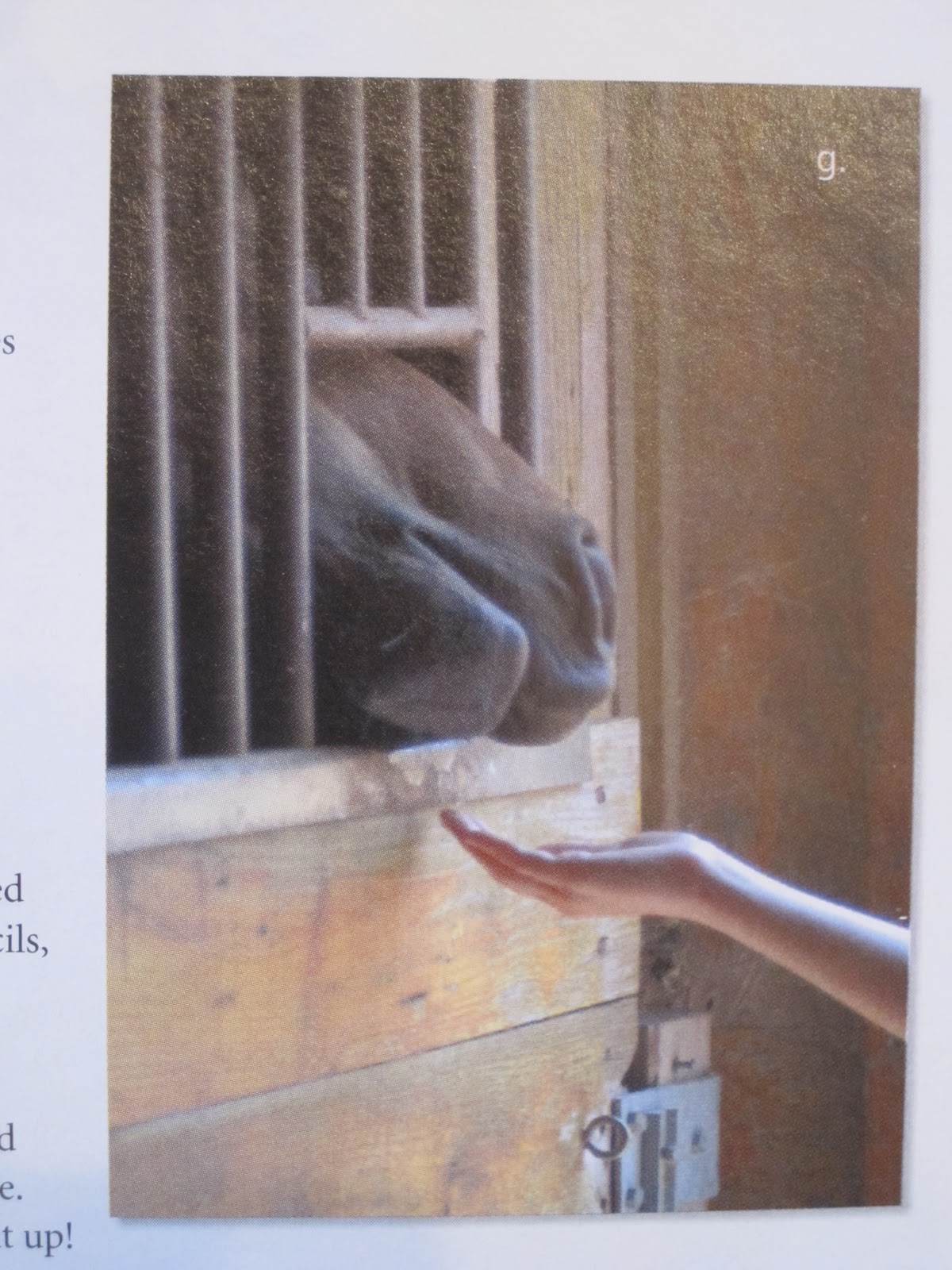
Look at the picture above. What do you see?

What you are looking at is a picture of a poster that is for sale for approximately 20 dollars in an American horse catalogue. The text beside the poster says: “The image of an inquisitive muzzle nuzzling a timid, but determined little hand evokes memories of an experience all horse lovers hold in common.”

The name of the poster is “The Gift”, but I am left unsure as to what gift this is referring to; the imprisoned horse giving the girl the gift of the nuzzle or the girl giving the imprisoned horse the gift of touch.

When I was a child, all the horse posters on my walls (and I assure you, there were MANY), illustrated various horses in freedom. I can’t remember one single one with a tacked up horse, let alone a ridden one or one stuck behind bars. Is this what the equestrian world has come to? Is taking the freedom of another living being so “normal” that it is now even depicted in posters for children? The above picture is supposed to evoke “memories of an experience we all hold in common”. I can tell you it definitely evokes my memories. In fact, some of those memories are of experiences from the not so distant past. I remember writing about one of those experiences in my blog (Levels of Imprisonment, August 29, 2010). I wrote: “But if there is a will, there is a way. The only opening to this horse’s box stall is a small gap above his feeder through which the barn worker delivers the daily grain portions. It is just big enough to fit a human hand and a scoop. And a horse’s muzzle. “

I was writing about a gelding who would twist his neck to an unconceivable angle just to get his nose pushed through the feeder hole. And why? To touch another horse.

Here is a picture I took much later of that very same horse. Unfortunately, this time his neighbor's window was closed and the two horses could not touch.  What you see is him reaching out to me.


The similarities to the poster are obvious, but the context completely different. Perhaps my memories are not the memories the catalogue was talking about…

Little Love and I have been gone from her old barn for a mere three weeks, but somehow that short time already feels like a lifetime. At her old barn horses lived in stalls exactly like the one in the poster picture. They rarely were able to touch each other. If it happened, it was an accident or the product of horse ingenuity. Perhaps the top electric wire broke between two pastures or the electricity was left off for a brief moment or a horse managed to get loose from his owner and ran to another horse. Or a horse stuck his nose through his feeder hole. But these were exceptions to the rule. And the rule was no touching.

When we were still there, I did my best to produce the horse to horse touch for Little Love. I know she would have preferred another horse to me as I am a sad replacement, but she took what she could get.

One day not so long ago I was scratching her over the withers, something she loves. As I started rubbing her hard with my fingers, she leaned into me with her nose wiggling. This prompted her new neighbor, a large gelding, to spin around in his stall and stare at me in disbelief. For a moment he merely observed what I was doing, then he took action. He pushed his head against the metal bars that separated his space from Little Love’s. I could see his eyes fix on me. “Come on, rub me, too” he was saying.

I continued rubbing Little Love with one hand as I pushed the fingers of my other hand through the bars. I could just about fit half my hand through. The gelding moved his head and let my fingers scratch over his forehead and nose. Then he positioned his neck to be in line with my hand. So there I stood, scratching Little Love’s withers with my left hand and with my right attempted to reach her neighbor, the big gelding. Both horses stretched their noses out in pleasure and breathed at each other through the bars of the stall.

We are mammals; we all have the need to touch each other and to be touched. Companionship is one of our basic needs, along with eating, drinking, moving and sex. Living in isolation can affect the mental state of any animal, but especially horses, as they are by nature herd animals. Isolation induces stress and a stressed animal cannot learn and train with 100% capacity. Yet ironically it is often the so called performance horses that live in such isolation.

I can now truly see the detriments of forcing an animal to live in a cage. Little Love, the horse that had not had any real horse-to-horse contact for over ten years, has now been going outside with her new friend Col for seven whole days. Due to this fact, she is a changed horse. She is more grounded, more relaxed, more at peace. Yes, she is still coming into a stall at night, but the fact that she can at all times reach over the wall and touch another of her kind, is huge.

I am happy I can finally give her the gift of a social life after all those years of isolation. And there are not a lot of things I enjoy more than watching Little Love interact with her first horse-friend in a decade. Hopefully someday she can give up stall living completely and join a herd living outside, but for the moment, she is visibly content with this small change to her life. In fact, she is so content, that someone could say she doesn’t need me anymore, at least not the way she “needed” me in her previous life. And there is some truth to that, since an imprisoned animal (or person, for that matter) will undoubtedly look forward to any interaction, even if it is with his captor and a member of another species. In that light, can we even pretend to have a real relationship with an animal that is kept in solitary confinement? I have to say that I still feel and hope I had a connection with Little Love before, when she lived a different life. This connection is now evolving and although I definitely have lost something precious (her undivided attention, perhaps?), I have also gained, and continue to gain something else in return, a whole new level of consciousness and connection I never knew about before.

This, I believe, is truly a gift.

~K

If you love something, set it free; if it comes back it's yours, if it doesn't, it never was.
- Anonymous

PS. There is another major detriment to the stall-bound life: insufficient movement. Horses are born to move and they should be allowed to move, day and night. Movement is what keeps their bodies healthy, starting from their hooves but affecting the joints, muscles and other tissues. A horse kept in a stall does not move enough and is thus prone to injury.


Two horses stretching out to touch each other

Tuesday, September 21, 2010

The difference

"When anything gets freed, a zest goes round the world." - Hortense Calisher


Look at the two pictures above. What is the difference between the two? Or is there a difference?


If I told you that I kept my dog Chili in a crate 23 hours a day just to take her out for a training session in the yard once a day with a muzzle on her face so she couldn't open her mouth, what would you think of me? Would it be the same if I told you my horse lived in a stall, but that I rode it every day for an hour to give it exercise?


Why does it seem unacceptable to treat a dog in the above described way, but it is a customary reality for many horses? Horses, like dogs, are born to move. In fact, they are so inclined to move that they stand up and start walking within the first few hours of their lives. Yet people find it acceptable to keep them in stalls, unmoving, day after day.

Before our paths crossed, Little Love used to live at a barn where she never left her stall for other than a riding session. For two years she was let loose a handful of time, each time resulting in some sort of injury.

"She went crazy when she was free," her owner reported to me, "so in the end we never let her free."

Right. That would make sense, wouldn't it? The problem, of course, was that there was no opportunity to put her outside or let her go in the arena on a regular basis. Perhaps in this case it was best to refrain from EVER doing it. I think Leonardo Da Vinci put it well when he said: "Once you have tasted flight, you will forever walk the earth with your eyes turned skyward, for there you have been, and there you will always long to return." Is it easier for horses to never be let loose than to get the opportunity once a year for thirty minutes or less?

I look at Little Love now, her confident calmness when I slip her halter off and let her loose in the arena or the pasture. She stands there and sniffs the air, then walks off to investigate the area. No crazy running, no injuries waiting to happen. And this only because she goes out in the pasture every day for four hours. That's it. Four hours of solitary freedom, a fraction of what she really needs. But what a difference it has made in who she is. I can only imagine who she would be if she didn't live in a stall at all, if she had access to movement every moment of her life.

So many people don't share (let alone understand) my passion for freeing all horses from stall living. Last winter when the weather was wet, the horses at the barn stayed inside for over two weeks straight. The pastures are grass and the barn owner wants to keep them in pristine condition, which means when it rains, the horses stay in. This happens periodically in the fall, winter and spring. Needless to say, Little Love turns into a maniac when her cabinfever rises. On days of complete stall confinement I do my best to go to the barn at times when others are not there to turn her loose in the arena. But life doesn't always work the way we want, and there are days when her only moment out of the stall is on the end of a rope or with a rider on her back. Which is not enough.

I had a casual conversation about this with the barn owner once, a conversation which started with the usual exchanges about the bad weather. Before I could complain about the horses having to stay inside for days, he brought the subject up himself.

"I don't understand what all the fuss is about horses having to go out every day. They are nice and cozy in their box stalls."

I looked at him in surprise. Had someone else actually voiced a concern? Was I not the only one here thinking this was total animal torture?

"Well, horses weren't exactly meant to live in stalls," I said, bravely. "Little Love is definitely a completely different horse when she gets to go out."

The barn owner gave me a scornful look. I could see I was quickly being labeled as one of those freaks who actually thought about horses' needs. Not that I didn't already have that label tattooed across my forehead before this conversation.

He let out a short laugh that sounded like a bark. "You know what? Ten years ago we didn't put the horses out for the entire winter, and they were fine. Three months inside. Horses don't care." Then he walked off. That was the last time we ever discussed the subject and what was there to discuss? The open hostility of his statement was enough to tell me this man was not going to change his thinking any time soon.

But I can't seem to get over this subject of captivity and freedom, it's as if my car is stuck on a hump in the road and no matter how hard I accelerate, I can't move forward and past it. Everywhere I look, there are horses being held prisoners and people holding them hostage.

A year ago a jumping horse passed through our barn. She was only there for a short while, but as soon as she arrived it was obvious that the mare hated being in a stall. She would kick the walls of her box sometimes non-stop for hours. Obviously this brought upon an injury and then another. As a solution, the owner attached leather straps around the mare's back legs, with a piece of chain on the back. This made kicking the barn walls extremely uncomfortable, although I have to give the mare points for trying. She also developed a bad habit of attacking everyone who passed her stall, which wasn't very pleasant as she lived in a busy location of the barn. Her aggression was not helped by the fact that when she kicked the walls, people would yell at her and even hit the bars of the stall with something, like a brush of a whip. I often stopped by her stall to talk to her, telling her that I understood what she was going through.

Finally, after months of fighting, the mare gave in and stopped the kicking. I was both relieved and sad to watch her surrender; relieved because I knew it would only get worse for her if she didn't stop and sad because the humans had managed to break her spirit. I admired her for her courage; the majority of horses don't dare express their opinions about stall living as vigorously as she did.  If they did, would it make a difference? 

But back to where we started: the two pictures at the top of this blog... If both these animals were locked up 24/7, would you feel more for - the dog or the horse? Or is it all the same? Where do you draw the line?

A goldfish in a fishtank.
A bird in a cage.
A dog in a crate.
A tiger in the zoo.
An elephant in the circus.
A seal in a bathtub.
A horse in a stall.

What is the difference?

~ K

"If I can stop one heart from breaking,
I shall not live in vain;
If I can ease one life the aching,
Or cool one pain,
Or help one fainting robin
Unto his next again,
I shall not live in vain."

- Emily Dickinson

Sunday, June 7, 2009

Separation

My good friend tells me how she often grooms her horse in liberty on the barn aisle. Most of the time he agrees to stand there without being restrained, but one day he decided to visit his friends with whom he goes out with. Except this time those friends were in their boxes behind bars and he was on the barn aisle, loose.

My friend quickly interrupted the sniffing between the horses and pushed her horse back into his place. Because… (she said to me) she had been taught to do so. And it is true. When I walk Little Love through the barn to the indoor arena and she stops to sniff another horse who is greeting her from his box, I urge her forward, pulling her away from the situation. If there was something I learned as a child, it was that horses should not touch each other when humans are handling them - ever. And this habit is engrained in my brain, etched into my behavior permanently, almost as if chiseled in stone. It is the unwritten rule of all barns.

So what is so bad about letting horses touch and say hello?

I guess someone would argue that horses could get excited, they could hurt each other or themselves or even the human holding them. Obviously letting two stallions touch might result in some sort of a commotion, but to let a gelding sniff a mare through the bars of a box – why not?

Does everything we do with these animals have to be about control, separation, deprivation of freedom?

Humans have put a lot of effort into imprisoning horses. Not only do we separate these herd animals into small boxes, we often also deny any contact whatsoever. I have seen barns where boxes are constructed of solid walls made out of wood or rock or cement, and horses cannot even see each other, let alone touch. I believe in the human world we call this solitary confinement, reserved only for convicts who have committed heinous crimes.

The barn where Little Love lives has beautiful green pastures, but each horse has their own and never under any circumstances do horses go out together. But fortunately they are able to see and touch with their neighbors through the metal bars of the box, which obviously is not much, but better than nothing. They can also stick their heads out of the small window on their door, at least the ones whose owners have not decided to keep the window closed to prevent accidents.

Most horses accept this order, either retreating to the privacy of their stall or occasionally sticking their heads out to look around. But there are some horses, that have learned how to bend the rules.

For example, there is a gelding, I’ll call him M for short, who hates his box with a passion. He also has a small window through which he can poke his head into the aisle, but because he likes to let everyone know loud and clear what he thinks about living in that jail of his, this window often has to be closed to stop him from kicking the door, not to mention all the halters and other reachable equipment he has destroyed with his teeth.

When you take M out of his stall, however, he doesn’t try to run outside, but instead pushes towards the mare that lives opposite to him. And almost as if planned ahead, she quickly meets him at her window and immediately, almost frantically, the two horses start to groom each other on the shoulder. This happens fast, with an air of madness as if to say “hurry before they break us up. Hurry, hurry!” So this is how they get their ten seconds of closeness before the gelding is torn away.

One day when I arrived at the barn, I discovered Little Love longing for the touch of another equine as well. She stretched her neck out as far as she could (and she has a long one, to her advantage) and reached with her nose towards Chispero, the gentle stallion across the aisle. And as I watched him meet her in the middle and kiss her softly on the nose, my heart broke a little bit more.

~K